

For decades, Africa has spoken passionately about integration, trade liberalization, connectivity, and economic unity. Yet despite these ambitions, one major barrier continues to slow the continent’s transformation: limited air connectivity between African nations.
At the center of the solution stands SAATM — the Single African Air Transport Market — one of the most ambitious aviation liberalization initiatives in African history.
But where does SAATM come from? Why has implementation been so slow? And what lessons can Africa learn from Europe’s successful Open Skies model?
As someone who has spent nearly two decades in aviation operations, airline coordination, charter management, and international aviation partnerships, I believe the time has come for Africa to move from declarations to implementation.
🔹 The Origins of SAATM
The roots of SAATM date back to the Yamoussoukro Decision (YD), adopted in 1999 by African Union member states in Yamoussoukro, Côte d’Ivoire. The objective was revolutionary: to liberalize African air transport markets by removing restrictions on traffic rights, capacity, frequency, tariffs, and market access among African airlines.
The vision was simple but powerful: allow African airlines to fly more freely within Africa, just as airlines operate within Europe or the United States.
However, implementation remained painfully slow for many years due to political, economic, and protectionist concerns. Recognizing this stagnation, the African Union officially launched SAATM in January 2018 during the AU Summit in Addis Ababa, Ethiopia, as a flagship project of Agenda 2063.
SAATM was designed to transform the Yamoussoukro Decision from a political declaration into a practical, operational reality.
🔹 Why SAATM Matters
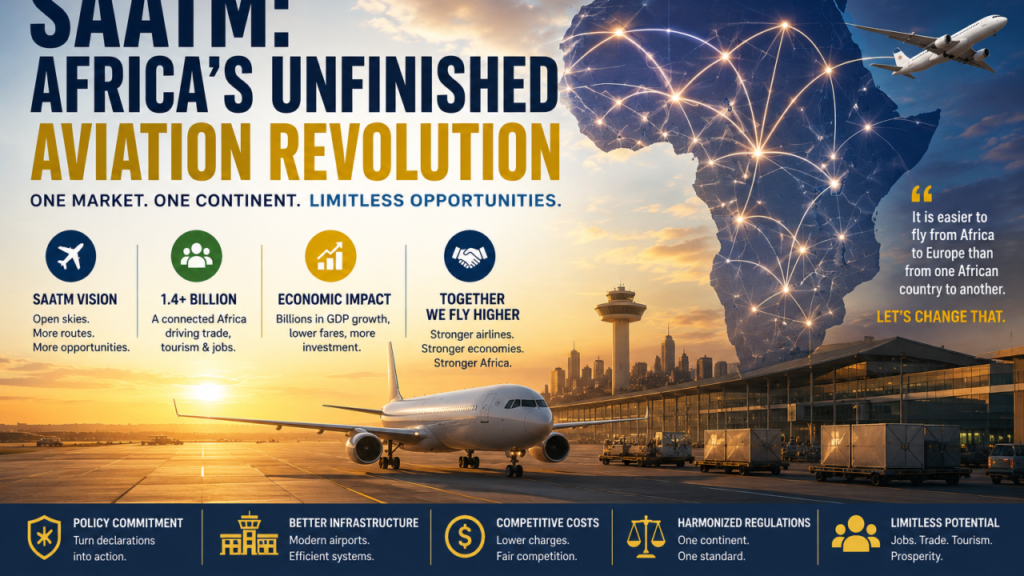
Africa represents over 1.4 billion people across 54 countries, characterized by rapid urbanization, a growing middle class, and massive untapped trade potential. Yet, the continent accounts for only a small fraction of global air traffic.
Shockingly, it remains easier to fly from many African cities to Europe than to a neighboring African country. A traveler flying between two close African nations may still need to transit through Europe or the Middle East due to poor intra-African connectivity.
This is not merely an aviation problem; it is an economic development challenge. Limited connectivity directly stifles trade, tourism, investment, cargo logistics, and business mobility.
Studies by IATA and AFRAA have consistently shown that a fully liberalized air transport market in Africa could generate millions of jobs, billions of dollars in GDP growth, increased tourism flows, and significantly lower airfares.
🔹 Europe’s Open Skies Success Story
When discussing SAATM, Europe’s aviation liberalization journey offers vital lessons. Before the late 1980s, European aviation was heavily regulated and controlled by national governments, much like many African markets today.
However, the phased introduction of the European Single Aviation Market—the “Open Skies” policy—transformed the continent. Airlines gained the freedom to operate freely, increase frequencies, and compete across borders. This birthed the low-cost carrier boom (Ryanair, easyJet) and led to massive passenger growth and deep regional integration.
The Key Lesson: Europe understood that protecting inefficient national monopolies ultimately harms consumers and the broader economy. However, Europe’s model succeeded because it was backed by a unified, legally enforceable regulatory framework. For SAATM to replicate this, the African Civil Aviation Commission (AFCAC) must be empowered with real enforcement teeth to penalize protectionist blockades.
🔹 The Current Status of SAATM
Today, over 35 African countries have joined SAATM, representing more than 80% of Africa’s aviation market. This is significant political progress. Several African airlines have expanded their regional networks, and some bilateral restrictions have gradually eased. There is also growing recognition that aviation connectivity is essential for the success of the African Continental Free Trade Area (AfCFTA).
However, the gap between policy declarations and operational reality remains one of SAATM’s biggest challenges. In practice, many airlines still face restricted traffic rights, slow regulatory approvals, and high operational costs.
🔹 Major Bottlenecks Slowing SAATM
1️⃣ Protectionism & Traffic Rights: Many governments still protect weak state carriers from competition. Crucially, the reluctant granting of Fifth Freedom traffic rights—the right to fly passengers between two foreign countries as part of a route—remains a major operational roadblock.
2️⃣ High Airport and Ground Handling Costs: Across several African countries, airport charges, excessive navigation fees, uncompetitive fuel prices, and ground handling monopolies artificially inflate operating costs.
3️⃣ Weak Aviation Infrastructure: Many African airports still lack modern terminal infrastructure, robust cargo facilities, efficient passenger processing systems, and local Maintenance, Repair, and Overhaul (MRO) capabilities.
4️⃣ Regulatory Fragmentation: Disconnected aviation regulations, certification standards, and approval processes create immense operational complexity for airlines operating across multiple African jurisdictions.
5️⃣ Visa Restrictions: Air connectivity alone is not enough. African travelers still face significant visa barriers within their own continent. A truly connected Africa requires both open skies and open borders. Forward-thinking nations like Rwanda, Kenya, Ghana, Benin, Seychelles, The Gambia, Senegal, Mauritius, and Togo deserve recognition for leading the charge in visa openness.
🚀 The Path Forward: Strategy and Private Investment
To accelerate sector modernization, Africa must strengthen private sector participation. Increased private investment in airports, cargo facilities, MRO hubs, aviation technology, and training academies will relieve the burden on state budgets and drive operational excellence.
We already have successful blueprints. Airlines such as Ethiopian Airlines, Kenya Airways, Royal Air Maroc, and RwandAir have shown the immense potential of African carriers to connect the continent effectively when supported by long-term strategic planning. Meanwhile, hubs like Addis Ababa, Nairobi, Casablanca, Kigali, Johannesburg, and Lomé demonstrate that Africa possesses the operational experience and market demand to make SAATM work.
🔹 Final Thoughts
SAATM is not simply an aviation policy; it is an African economic integration project. If fully implemented, it will transform African trade, tourism, logistics, and economic competitiveness.
Africa now faces a defining question: Will the continent continue protecting fragmented, inefficient national markets, or will it finally embrace the bold integration vision required for Africa’s future?
The future of African connectivity depends on the answer.