

Ghana: West Africa’s Emerging Aviation Gateway, Economic Powerhouse, and the Connectivity Gaps That Could Shape Its Future
By Hailegebrel Tadese SEBOKA
Aviation & Charter Operations Professional | African Aviation Connectivity Strategist
Executive Summary
Ghana stands at a critical juncture in its aviation development journey. With political stability, modern airport infrastructure, a diversified economy, and a strategic geographic location along the Gulf of Guinea, the country possesses many of the essential ingredients required to emerge as one of Africa’s leading aviation gateways.
Yet despite these advantages, several important African and intercontinental markets remain underserved or entirely unserved. While Accra enjoys strong connectivity to Europe, the Middle East, and selected African destinations, significant opportunities exist to strengthen Ghana’s position as a regional aviation hub.
This Week 8 edition of the African Connectivity Analysis series examines Ghana’s aviation infrastructure, international connectivity, cargo potential, charter and ACMI opportunities, and the strategic route gaps that could define the country’s future role within Africa’s evolving aviation ecosystem.
Introduction
Following analyses of Ethiopia, Rwanda, South Africa, Kenya, Angola, Nigeria, and Zimbabwe in Weeks 1–7, this week’s study focuses on Ghana—one of West Africa’s most stable economies and one of the continent’s most promising aviation markets.
Situated along the Gulf of Guinea, Ghana occupies a strategic position between West Africa, Europe, North America, and the Middle East. The country has established itself as a regional center for finance, diplomacy, mining, energy, and international development. Combined with political stability, modern aviation infrastructure, and a growing middle class, Ghana possesses many of the characteristics required to become a leading aviation gateway for West Africa.
With a population of approximately 35 million people and a diversified economy supported by services, mining, oil and gas, manufacturing, agriculture, and international trade, Ghana continues to attract substantial foreign investment and regional business activity.
Despite these advantages, Ghana’s aviation potential remains only partially realized. While Accra enjoys strong international connectivity, several high-value African and intercontinental markets remain underserved or entirely unserved.
The next phase of growth will depend not only on strengthening existing routes but also on developing strategic connections that position Ghana as a true regional aviation hub.
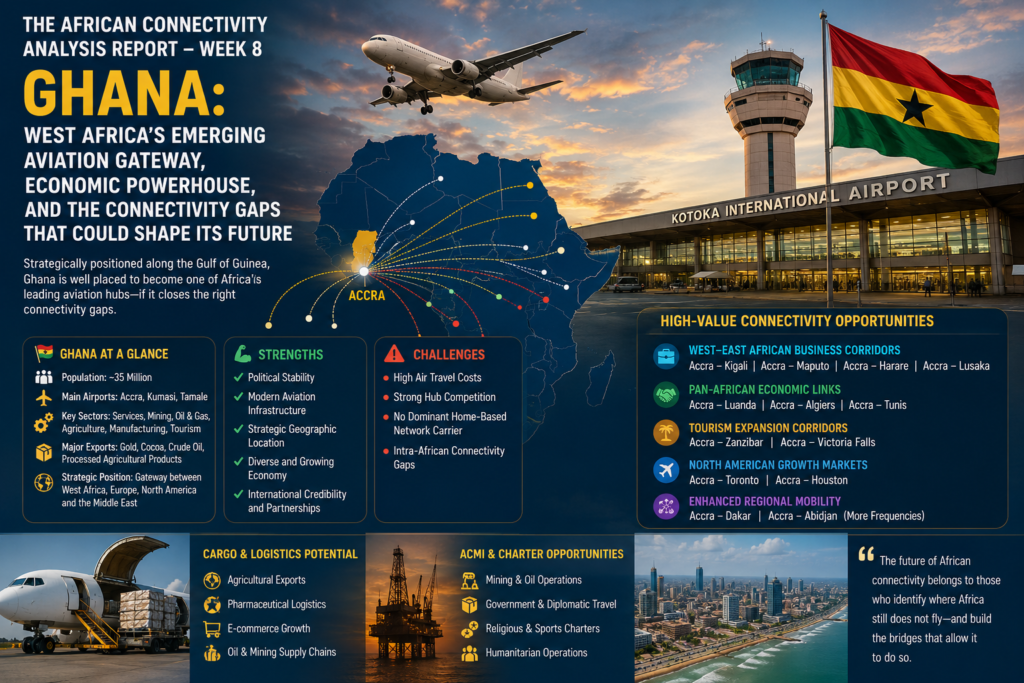
Ghana at a Glance
- Population: Approximately 35 million
- Main Airports: Kotoka International Airport (Accra), Prempeh I International Airport (Kumasi), Tamale International Airport
- Key Economic Sectors: Services, Mining, Oil & Gas, Agriculture, Manufacturing, Tourism
- Major Exports: Gold, Cocoa, Crude Oil, Processed Agricultural Products, Manganese
- Current International Airlines: Ethiopian Airlines, Emirates, Qatar Airways, British Airways, KLM, Turkish Airlines, Brussels Airlines, Kenya Airways, ASKY Airlines, Air Côte d’Ivoire
- Strategic Position: Gateway between West Africa, Europe, North America, and the Middle East
Aviation Infrastructure: A Three-Gateway Network
Ghana’s aviation ecosystem revolves around three strategic airports, each supporting a distinct economic function.
Kotoka International Airport (Accra)
Ghana’s principal international gateway and one of the most modern airports in Africa. Accra serves as the country’s diplomatic, commercial, financial, and governmental center while increasingly functioning as a regional hub for intercontinental and intra-African travel.
Prempeh I International Airport (Kumasi)
Located in Ghana’s second-largest city, Kumasi supports the commercial and industrial activities of the Ashanti Region. The airport plays an increasingly important role in domestic connectivity and regional economic integration.
Tamale International Airport
Strategically positioned in Northern Ghana, Tamale supports agricultural exports, regional trade, humanitarian operations, and future cargo development opportunities linking the Sahel region with coastal West Africa.
International Connectivity
Ghana maintains strong international links through major African, European, Middle Eastern, and transatlantic carriers, including:
- Ethiopian Airlines
- Emirates
- Qatar Airways
- British Airways
- KLM
- Turkish Airlines
- Brussels Airlines
- Kenya Airways
- ASKY Airlines
- Air Côte d’Ivoire
These carriers connect Ghana to major business, tourism, diplomatic, and diaspora markets across multiple continents.
Nevertheless, Accra remains underconnected to several important African markets relative to its economic influence and geographic position.
ACMI and Charter Potential
Ghana presents significant opportunities for charter operators and ACMI providers.
Key Demand Drivers
- Mining Sector Movements: Dedicated flights supporting gold, manganese, and mineral extraction activities.
- Oil & Gas Operations: Crew rotations and technical movements serving offshore energy projects.
- Government & Diplomatic Travel: Frequent movements associated with regional organizations, embassies, and international institutions.
- Religious Tourism: Growing pilgrimage and faith-based travel demand.
- Sports & Entertainment Charters: Dedicated aircraft supporting major regional events and international competitions.
- Humanitarian Operations: Support for NGO and development sector activities across West Africa.
Cargo and Logistics Opportunities
Accra is well positioned to become a leading cargo gateway in West Africa.
Key Opportunities
- Agricultural Exports: Fresh fruits, vegetables, flowers, and high-value perishables destined for European and Middle Eastern markets.
- Pharmaceutical Logistics: Growing demand for temperature-controlled cargo facilities.
- E-commerce Distribution: Expansion of regional fulfillment and express delivery networks.
- Oil & Mining Supply Chains: Movement of specialized equipment, spare parts, and industrial freight.
Structural Challenges vs. Strategic Opportunities
Key Constraints
- High air travel costs resulting from airport charges and taxation.
- Strong competition from Lagos, Abidjan, Lomé, Addis Ababa, and Nairobi.
- Absence of a dominant home-based network carrier capable of building a large-scale connecting hub.
- Persistent intra-African connectivity gaps.
Growth Catalysts
- Implementation of SAATM.
- Continued airport infrastructure development.
- Sustained economic growth and trade expansion.
- Strategic airline partnerships and alliances.
Africa’s Aviation Growth Context
According to IATA’s long-term forecasts, Africa will remain one of the world’s fastest-growing aviation markets through 2050. Rising incomes, urbanization, demographic growth, and continental integration initiatives such as the African Continental Free Trade Area (AfCFTA) and the Single African Air Transport Market (SAATM) are expected to generate substantial growth in passenger and cargo demand.
Ghana is particularly well positioned to benefit from these trends given its stable business environment, strategic location, and modern aviation infrastructure.
Ghana’s Missing Connections: Where the Value Lies
The greatest opportunity for Ghanaian aviation lies not in increasing frequencies on existing routes but in closing critical connectivity gaps across Africa and beyond.
Using a methodology based on airline schedules, airport publications, tourism flows, trade volumes, business demand, and GDS verification, several opportunities emerge.
West-East African Business Corridors
- Accra – Maputo
- Accra – Harare
- Accra – Lusaka
Pan-African Economic Links
- Accra – Luanda
- Accra – Algiers
- Accra – Tunis
Tourism Expansion Corridors
- Accra – Zanzibar
- Accra – Victoria Falls
North American Growth Opportunities
- Accra – Toronto
- Accra – Houston
Enhanced Regional Mobility
- Additional frequencies on Accra – Dakar
Final Assessment
Ghana’s aviation potential extends far beyond its current traffic volumes. Its greatest strengths lie in its political stability, modern infrastructure, strategic geographic position, diversified economy, and increasing importance as a diplomatic and commercial center.
Unlike many African aviation markets that must first overcome significant structural barriers, Ghana already possesses much of the foundation required for sustainable aviation growth.
The next phase of development will depend on expanding underserved markets, attracting additional airline investment, strengthening cargo infrastructure, and positioning Accra as a genuine connecting hub for West Africa.
As Africa advances toward greater economic and aviation integration through AfCFTA and SAATM, countries capable of bridging connectivity gaps will capture a disproportionate share of future growth.
Ghana possesses the infrastructure, economic fundamentals, geographic advantages, and institutional stability necessary to become one of Africa’s most influential aviation gateways.
The future of African connectivity belongs to those capable of identifying where Africa still does not fly—and building the bridges that allow it to do so.