

Algeria: Unlocking North Africa’s Untapped Aviation Potential
Executive Summary
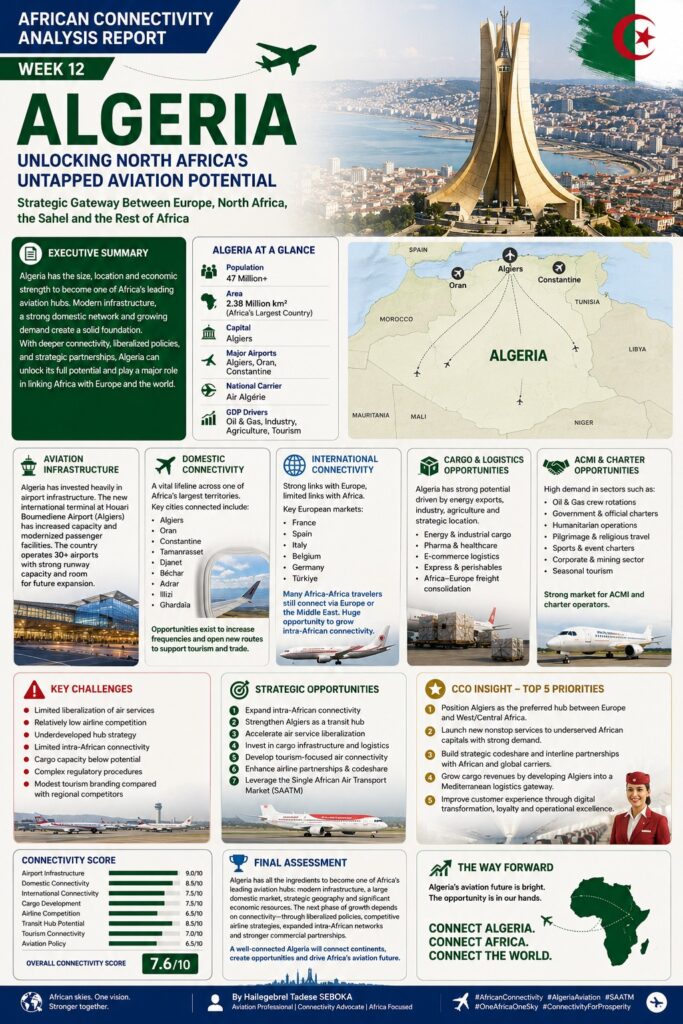
Algeria possesses one of Africa’s largest aviation markets by geography, population, and economic capacity, yet it remains significantly underutilized compared with other major aviation hubs on the continent.
Strategically positioned between Europe, the Mediterranean, the Sahel, and West Africa, Algeria has all the foundational elements to become one of Africa’s leading aviation gateways. While substantial investments have modernized its airport infrastructure, international connectivity, airline competition, cargo development, and transit traffic continue to lag behind their true potential.
This report examines Algeria’s aviation ecosystem, highlights its competitive strengths and structural challenges, identifies high-potential underserved markets, and presents strategic recommendations that could position Algiers as one of Africa’s leading aviation hubs.
Introduction
For the past eleven weeks, the African Connectivity Analysis series has evaluated key aviation markets across the continent, including Rwanda, South Africa, Ethiopia, Kenya, Angola, Nigeria, Ghana, Zimbabwe, Egypt, Senegal, and Morocco. Each country has demonstrated unique strengths and challenges in advancing African air connectivity.
This week, the spotlight turns to Algeria—Africa’s largest country by land area and one of its most strategically located nations.
The Central Question
Can Algeria transform its strategic geographic advantage into North Africa’s next major aviation powerhouse?
Algeria at a Glance
| Parameter | Overview |
| Capital | Algiers |
| Population | Approximately 47 million |
| Land Area | 2.38 million km² (Africa’s largest country) |
| National Carrier | Air Algérie |
| Major Airports | Houari Boumediene Airport (ALG), Oran Ahmed Ben Bella Airport (ORN), Constantine Mohamed Boudiaf Airport (CZL) |
| Key Economic Drivers | Oil & Gas, Manufacturing, Agriculture, Infrastructure, Tourism |
Aviation Infrastructure
Over the past decade, Algeria has made substantial investments in modernizing its airport infrastructure. The new international terminal at Houari Boumediene Airport has significantly expanded passenger handling capacity while improving operational efficiency and passenger experience.
Today, Algeria operates more than 30 airports, providing extensive domestic coverage across Africa’s largest country by land area.
Key Strengths
- Modern international gateway at Algiers.
- Extensive domestic airport network.
- Advanced air navigation systems.
- Significant runway and terminal capacity.
- Strong foundation for future expansion.
Strategic Observation
Infrastructure alone does not create a successful aviation hub. Sustainable growth also requires competitive airline strategies, expanded route networks, commercial partnerships, efficient hub scheduling, and progressive aviation policies.
Domestic and International Connectivity
Domestic Connectivity
Domestic aviation plays a vital role in connecting Algeria’s vast territory.
Key domestic destinations include:
- Algiers
- Oran
- Constantine
- Tamanrasset
- Djanet
- Béchar
- Adrar
- Illizi
- Ghardaïa
Domestic air services support:
- Government mobility
- Energy and oil & gas operations
- Tourism
- Business travel
- Regional economic development
Although domestic coverage is extensive, increasing flight frequencies would further strengthen national connectivity and economic activity.
International Connectivity
Europe remains Algeria’s primary international aviation market, with strong links to:
- France
- Spain
- Italy
- Belgium
- Germany
- Türkiye
However, connectivity with Sub-Saharan Africa remains relatively limited.
Many passengers travelling between North Africa and Sub-Saharan Africa continue to connect through:
- Addis Ababa
- Casablanca
- Istanbul
- Doha
- Paris
This represents a significant opportunity for Algiers to establish itself as a competitive transit hub linking Europe, North Africa, West Africa, Central Africa, and the Sahel.
High-Potential and Underserved Routes from Algiers (ALG)
Developing strategically selected African routes would allow Air Algérie to capture transit traffic that is currently flowing through competing hubs.
West Africa
- Lagos
- Accra
- Monrovia
- Freetown
- Banjul
Central Africa
- Brazzaville
- Kinshasa
East Africa
- Dar es Salaam
- Kigali
- Entebbe
- Addis Ababa (additional capacity and frequency enhancement)
Southern Africa
- Cape Town
- Windhoek
- Lusaka
Indian Ocean
- Antananarivo
- Mauritius
- Seychelles
These markets present growing demand driven by:
- Business travel
- African Continental Free Trade Area (AfCFTA)
- Energy and mining industries
- Government travel
- Tourism
- Humanitarian operations
- African diaspora
- Air cargo
Cargo and Logistics Opportunities
Algeria possesses considerable cargo potential due to its:
- Large industrial sector
- Energy exports
- Agricultural production
- Pharmaceutical imports
- Strategic Mediterranean location
Future growth opportunities include:
- Cross-border e-commerce logistics
- Pharmaceutical cold-chain services
- Express cargo
- Africa–Europe freight consolidation
- Perishable exports
Developing dedicated cargo infrastructure and attracting additional cargo operators would significantly strengthen Algeria’s logistics competitiveness.
ACMI and Charter Opportunities
Algeria offers attractive opportunities for ACMI and charter operators, particularly in:
- Oil and gas crew rotations
- Government charters
- Humanitarian operations
- Religious pilgrimages
- Sports charters
- Corporate travel
- Mining sector support
- Seasonal tourism
Professional Insight
Drawing on more than 18 years of experience coordinating humanitarian charter operations across Africa, I believe Algeria represents one of the continent’s most promising emerging charter markets. Stronger collaboration between governments, airlines, and charter operators could unlock substantial operational and commercial value.
CCO Perspective: Strategic Priorities for Air Algérie
If I were Chief Commercial Officer of Air Algérie, my strategic priorities over the next five years would be:
- Position Algiers as the preferred hub linking Europe with West and Central Africa.
- Launch nonstop services to underserved African capitals with strong business, government, and diaspora demand.
- Expand strategic codeshare and interline partnerships with African and international airlines.
- Develop Algiers into a leading Mediterranean cargo and logistics gateway.
- Enhance customer experience through digital transformation, loyalty programme improvements, and operational excellence.
Connectivity Assessment
| Category | Assessment | Observations |
| Airport Infrastructure | Excellent | Modern airports, significant capacity, and strong operational capabilities provide a solid foundation for future growth. |
| Domestic Connectivity | Strong | An extensive domestic network effectively connects major cities and remote regions across Africa’s largest country by land area. |
| International Connectivity | Moderate | Strong links with Europe, but significant opportunities remain to expand direct services across Africa. |
| Cargo Development | Developing | Considerable potential exists to strengthen air cargo, logistics, cold-chain services, and e-commerce distribution. |
| Airline Competition | Limited | Greater market liberalization and increased competition would stimulate connectivity, service quality, and network expansion. |
| Transit Hub Potential | Very High | Algiers is strategically positioned to become a major gateway linking Europe, North Africa, the Sahel, West Africa, and Central Africa. |
| Tourism Connectivity | Growing | Improved air connectivity and destination marketing could significantly enhance inbound tourism. |
| Aviation Policy | Evolving | Continued implementation of liberal aviation policies and alignment with the Single African Air Transport Market (SAATM) would accelerate sector growth. |
Overall Assessment
Algeria possesses one of Africa’s strongest foundations for aviation growth. Its modern infrastructure, strategic geographic location, extensive domestic network, and economic strength position the country to become one of the continent’s leading aviation hubs. Unlocking this potential will depend on expanding intra-African connectivity, strengthening commercial partnerships, enhancing airline competitiveness, developing cargo capabilities, and advancing air transport liberalization.
Final Assessment
Algeria possesses all the essential ingredients required to become one of Africa’s leading aviation hubs: modern infrastructure, a large domestic market, strategic geography, and significant economic resources.
However, the next phase of growth will depend less on infrastructure development and more on strategic execution through:
- Accelerating air service liberalization under the Single African Air Transport Market (SAATM).
- Expanding intra-African connectivity.
- Encouraging greater airline competition.
- Strengthening airline partnerships and codeshare agreements.
- Developing Algiers into a competitive dual-bank transit hub linking Europe, North Africa, the Sahel, West Africa, Central Africa, and beyond.
If these priorities are successfully implemented, Algeria can play a transformative role in connecting Africa with Europe while supporting regional integration, trade, tourism, investment, and the objectives of the African Continental Free Trade Area (AfCFTA).
Sources and References
This analysis is based on publicly available information from the International Air Transport Association (IATA), the International Civil Aviation Organization (ICAO), Airports Council International (ACI), the African Airlines Association (AFRAA), the World Bank, the African Development Bank (AfDB), official airport and airline publications, published schedules, and aviation industry reports. It also reflects professional insights drawn from more than 18 years of experience in the African aviation sector.