

Tunisia: North Africa’s Mediterranean Crossroads, Industrial Hub, and Strategic Bridge Connecting Africa to Europe
Executive Summary
Tunisia occupies a uniquely advantageous position in North Africa. With a mature tourism sector, a diversified manufacturing base, a highly skilled workforce, and a strategic location along Mediterranean shipping and aviation corridors, the country serves as a vital bridge between Europe, West Africa, and the Middle East.
Unlike markets that rely on a single mega-hub, Tunisia benefits from a multi-airport system anchored by Tunis-Carthage International Airport (TUN) for business, diplomatic, and scheduled international traffic, complemented by Enfidha-Hammamet (NBE), Monastir (MIR), and Djerba-Zarzis (DJE), which specialize in European leisure and charter operations.
Despite these strengths, Tunisia’s aviation sector—led by Tunisair—continues to face financial restructuring, fleet limitations, and increasing competition from European low-cost carriers (LCCs) and major Middle Eastern airlines. Nevertheless, the implementation of the Single African Air Transport Market (SAATM) and the African Continental Free Trade Area (AfCFTA) presents a unique opportunity for Tunisia to evolve from a predominantly North–South leisure gateway into a strategic East–West and Sub-Saharan African connectivity hub.
This Week 13 edition of the African Connectivity Analysis Report examines Tunisia’s aviation infrastructure, airline industry, cargo and charter opportunities, strategic challenges, and future network development potential.
Introduction
Following analyses of Ethiopia, Rwanda, South Africa, Kenya, Angola, Nigeria, Zimbabwe, Ghana, Egypt, Senegal, Morocco, and Algeria, this edition focuses on Tunisia, one of North Africa’s most diversified and industrially integrated economies.
Located less than three hours from many Southern European cities, Tunisia has long leveraged its geographic proximity to Europe to strengthen trade, tourism, manufacturing, and investment. With a population exceeding 12 million, Tunisia has developed into a major exporter of automotive components, textiles, electrical equipment, olive oil, phosphates, and agricultural products.
The country’s aviation sector is centered on Tunisair, supported by Nouvelair, Tunisair Express, and several charter operators. As Tunisair continues its fleet renewal with Airbus A320neo aircraft and broader operational restructuring, significant opportunities exist to strengthen connectivity with West Africa, Central Africa, and selected long-haul markets.
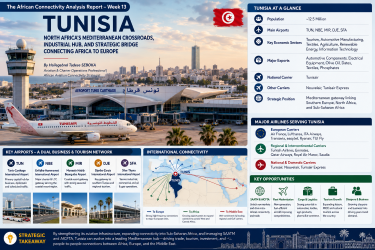
Tunisia at a Glance
- Population: Approximately 12.5 million
- Primary Airports:
- Tunis-Carthage International Airport (TUN)
- Enfidha-Hammamet International Airport (NBE)
- Monastir Habib Bourguiba International Airport (MIR)
- Djerba-Zarzis International Airport (DJE)
- Sfax-Thyna International Airport (SFA)
- Major Industries: Tourism, Automotive Manufacturing, Textiles, Agriculture, Renewable Energy, Information Technology
- Major Exports: Automotive Components, Electrical Equipment, Olive Oil, Dates, Textiles, Phosphates
- National Carrier: Tunisair
- Other Airlines: Nouvelair, Tunisair Express
- Strategic Role: Mediterranean gateway connecting Europe, North Africa, and Sub-Saharan Africa
Aviation Infrastructure: A Balanced Business and Tourism Network
Tunisia’s airport network is designed to serve both business and tourism demand.
Tunis-Carthage International Airport (TUN) remains the country’s principal gateway, handling government, diplomatic, business, and scheduled international traffic while serving as the operational hub for Tunisair and Nouvelair.
Enfidha-Hammamet and Monastir specialize in European charter and leisure traffic, accommodating high seasonal passenger volumes from key tourism markets.
Djerba-Zarzis serves southern Tunisia’s tourism industry and supports regional connectivity.
Sfax-Thyna primarily supports business aviation, industrial activities, and regional operations.
International Connectivity
Tunisia enjoys strong connectivity with Europe, particularly France, Italy, and Germany, driven by tourism, business travel, and diaspora demand.
Major international airlines serving Tunisia include:
- Tunisair
- Nouvelair
- Air France
- Lufthansa
- ITA Airways
- Transavia
- easyJet
- Ryanair
- TUI Fly
- Turkish Airlines
- Emirates
- Qatar Airways
- Royal Air Maroc
- Saudia
While European connectivity is well established, direct services to West and Central Africa remain limited, presenting significant opportunities for future expansion.
ACMI and Charter Market Potential
Tunisia offers considerable opportunities for ACMI and charter operations driven by:
- Seasonal European tourism
- Corporate shuttle services supporting manufacturing industries
- Hajj and Umrah traffic
- Humanitarian and government operations
- Business aviation supporting energy and industrial sectors
Cargo and Logistics Opportunities
Tunisia’s industrial base creates strong potential for both dedicated freighter operations and belly-hold cargo.
Priority cargo sectors include:
- Automotive components
- Electronics
- Textile exports
- Agricultural perishables
- Pharmaceuticals
- E-commerce and express logistics
Its proximity to Europe positions Tunisia as an attractive regional logistics platform.
Challenges and Opportunities
Key Challenges
- Ongoing fleet modernization at Tunisair
- Intense competition from European low-cost carriers
- Capacity constraints at Tunis-Carthage Airport
- Bilateral air service limitations with several African countries
Strategic Opportunities
- Implementation of SAATM
- AfCFTA-driven trade growth
- Fleet modernization with fuel-efficient aircraft
- Expansion of nearshoring industries
- Growing diaspora and business travel demand
Strategic Unserved Route Opportunities from Tunis
Lagos (Nigeria)
Africa’s largest economy and most populous city. A direct route would strengthen business travel, trade, financial services, energy sector links, and cargo connectivity while positioning Tunis as a gateway between West Africa and Europe.
Accra (Ghana)
A leading regional hub for diplomacy, finance, mining, and technology. Direct flights would support growing business travel, tourism, and connections between West Africa, North Africa, and Europe.
Kinshasa (Democratic Republic of the Congo)
One of Africa’s largest metropolitan areas with significant mining and infrastructure potential. A direct service would facilitate business investment, government cooperation, humanitarian operations, and cargo movements.
Douala (Cameroon)
Central Africa’s principal commercial and maritime gateway. This route would strengthen trade, industrial cooperation, and cargo flows while connecting Central Africa with Tunisia and Europe.
Yaoundé (Cameroon)
Cameroon’s political and administrative capital. Direct services would support diplomatic travel, international organizations, business missions, and complement the commercial importance of Douala.
Increase Frequencies to Dakar (Senegal)
A rapidly growing West African aviation and business hub. Additional frequencies would improve connectivity, support tourism, facilitate government and corporate travel, and strengthen Tunisia’s presence in Francophone Africa.
Increase Frequencies to Abidjan (Côte d’Ivoire)
One of West Africa’s strongest financial and commercial centers. Increased services would support expanding trade, investment, banking, and corporate travel while improving onward connections through Tunis.
Washington, D.C. (USA)
A global diplomatic and institutional center. A direct route would enhance government relations, international organization connectivity, tourism, and business travel while providing North African access to the U.S. capital region.
Overall Strategic Objective
These routes would:
- Strengthen Tunisia’s position as a North African gateway.
- Improve connectivity between Europe, North Africa, West Africa, Central Africa, and North America.
- Support AfCFTA and increased intra-African trade.
- Diversify Tunisair’s network beyond traditional European markets.
- Increase passenger traffic, cargo volumes, and transit opportunities through Tunis-Carthage Airport.
Cargo Development Priorities
Tunis – Frankfurt
Europe’s largest cargo and logistics hub, supporting automotive, pharmaceuticals, high-value manufacturing, and industrial exports.
Tunis – Milan
Strengthens trade with one of Tunisia’s largest economic partners, particularly in textiles, fashion, manufacturing, machinery, and automotive components.
Tunis – Dakar
Creates an important West African logistics corridor supporting agricultural products, pharmaceuticals, consumer goods, and regional trade.
Tunis – Abidjan
Connects Tunisia with one of West Africa’s fastest-growing economies, facilitating industrial exports, perishables, pharmaceuticals, and business cargo.
Sfax – Marseille
Supports Tunisia’s second-largest industrial region by facilitating exports of seafood, olive oil, agricultural products, and manufactured goods to southern Europe.
Sfax – Genoa
Strengthens maritime and industrial supply chains between Tunisia and northern Italy while supporting machinery, automotive components, industrial equipment, and agricultural exports.
Strategic Cargo Objective
These corridors would:
- Diversify Tunisia’s cargo network.
- Increase export competitiveness.
- Support automotive, pharmaceutical, industrial, textile, and agricultural sectors.
- Position Tunisia as a logistics bridge linking Europe, North Africa, and Sub-Saharan Africa.
- Generate additional cargo revenue while strengthening the country’s
Strategic Observation
Tunisia’s long-term aviation success depends on expanding beyond its traditional European leisure market. By leveraging its geographic position, modernizing its aviation infrastructure, embracing SAATM, and strengthening connectivity with West and Central Africa, Tunisia can evolve into a highly competitive Mediterranean hub connecting Africa with Europe and the Middle East.
Developing coordinated hub operations at Tunis-Carthage will enable Tunisair and its partners to offer efficient transfer opportunities while supporting trade, tourism, and economic integration across the continent.
Final Assessment
Tunisia possesses many of the ingredients required to become one of Africa’s leading aviation gateways: a strategic location, diversified economy, strong tourism industry, established manufacturing sector, and modern airport network.
The next phase of growth will depend on accelerating fleet modernization, expanding connectivity into Sub-Saharan Africa, improving airport capacity, and capitalizing on the opportunities created by SAATM and AfCFTA.
If these priorities are successfully implemented, Tunisia can strengthen its role as North Africa’s Mediterranean crossroads and emerge as an increasingly important hub for passenger mobility, cargo logistics, trade, and investment connecting Africa with Europe and beyond.