

Tanzania: Unlocking East Africa’s Aviation Potential Through Tourism, Connectivity, and Strategic Investment
Tanzania is rapidly emerging as one of East Africa’s most promising aviation growth markets. With a population of over 70 million, world-renowned tourism attractions, expanding airport infrastructure, and the continued transformation of Air Tanzania (TC), the country is strategically positioned to become one of Africa’s leading aviation gateways.
Located at the crossroads of East, Southern, and Central Africa, Tanzania enjoys significant geographic advantages for passenger and cargo connectivity. Unlike many African aviation markets that depend primarily on business travel, Tanzania benefits from a diversified demand base driven by international tourism, mining, agriculture, government travel, trade, humanitarian operations, and growing intra-African mobility.
To fully unlock its aviation potential, Tanzania must capitalize on the opportunities created by the African Continental Free Trade Area (AfCFTA) and the Single African Air Transport Market (SAATM). Future success will depend less on fleet expansion alone and more on network optimization, frequency growth, strategic partnerships, and cargo development.
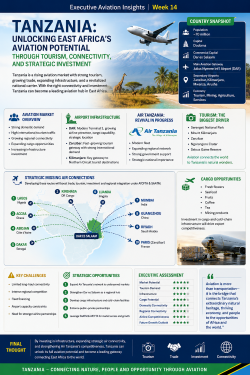
📌 Country & Aviation Profile
Population: ~70 Million
A rapidly growing market generating increasing demand for domestic, regional, and international travel.
Capital / Commercial Hub: Dodoma / Dar es Salaam
Dual administrative and commercial centres creating diversified passenger flows.
Primary Gateway: Julius Nyerere International Airport (DAR)
Tanzania’s principal international gateway and future regional hub.
Strategic Secondary Gateways
• Zanzibar (ZNZ) – Premium leisure gateway connecting Tanzania with Europe, the Middle East and global tourism markets.
• Kilimanjaro (JRO) – Gateway to Tanzania’s Northern Tourism Circuit, including Serengeti, Ngorongoro and Mount Kilimanjaro.
• Mwanza (MWZ) – Supports mining, fisheries, agriculture and Lake Victoria regional commerce.
🏗️ Airport Infrastructure Strategy
1. Julius Nyerere International Airport (DAR)
Tanzania’s Future Regional Hub
Role
Primary international gateway and future connecting hub.
Strengths
• Modern Terminal 3
• Excellent geographic position between Southern, Eastern and Central Africa
• Strong cargo potential
• Growing international network
Strategic Priority
Develop synchronized banked arrival and departure waves allowing seamless connections between Southern Africa, East Africa, West Africa, the Middle East and Asia.
2. Abeid Amani Karume International Airport (ZNZ)
Africa’s Premium Island Gateway
Role
International leisure gateway.
Strengths
• Premium tourism market
• High-yield European traffic
• Strong Middle Eastern connectivity
Priority
Continue expansion of apron capacity, passenger facilities and baggage handling systems to support continued tourism growth.
3. Kilimanjaro International Airport (JRO)
Northern Tanzania Tourism Hub
Role
Gateway to East Africa’s premier safari destinations.
Strengths
• Premium international passengers
• Strong tourism demand
• Agricultural export potential
Priority
Expand cold-chain logistics facilities to support high-value agricultural exports.
✈️ Air Tanzania (TC): Fleet Utilization & Network Strategy
Air Tanzania now possesses one of Africa’s youngest and most versatile fleets.
Fleet Deployment Strategy
Dash 8-Q400
Ideal for:
• Domestic routes
• Secondary city connectivity
• Regional feeder services
Airbus A220-300
Ideal for:
• Medium-density African routes
• High-frequency regional operations
• Hub feed into Dar es Salaam
Boeing 787-8 Dreamliner
Ideal for:
• Long-haul passenger markets
• Premium tourism routes
• High-demand African services
Boeing 767-300 Freighter
Ideal for:
• Agricultural exports
• Seafood
• Mining cargo
• Regional logistics
Strategic Fleet Recommendations
Optimize Widebody Utilization
Rather than spreading widebody aircraft across multiple marginal long-haul routes, Air Tanzania should prioritize markets delivering stronger passenger and cargo yields.
Increasing frequencies to Guangzhou (CAN) offers greater long-term commercial value through stronger bilateral trade, seafood exports, perishables, electronics imports and belly cargo demand.
Build Regional Frequency
Deploy additional Airbus A220 aircraft on major African trunk routes including:
• Lagos
• Johannesburg
• Accra
• Lusaka
• Harare
Higher frequencies create stronger connectivity while improving aircraft utilization and passenger convenience.
🗺️ Consolidated Route Development Strategy
Strengthen Existing Strategic Routes
DAR – Lagos (LOS)
Increase from 3 weekly to daily
Connects East Africa with West Africa’s largest economy while supporting AfCFTA business and cargo flows.
DAR – Johannesburg (JNB)
Increase from 3 weekly to daily
Strengthens Southern African connectivity and improves network feed.
DAR – Guangzhou (CAN)
Increase to 5–7 weekly
Maximizes passenger demand and high-value cargo opportunities.
DAR – Accra (ACC)
Increase from 3 weekly to 5 weekly
Provides direct access to the AfCFTA Secretariat and Ghana’s rapidly growing financial and commercial sector.
🟢 High-Priority Greenfield Opportunities
Dar es Salaam – Dakar (DSS)
Priority: High | Aircraft: Airbus A220-300 / Boeing 787-8
A direct link would connect East and West Africa while supporting trade, diplomacy, tourism, humanitarian operations, and business travel. Dakar is one of West Africa’s most important political, commercial, and aviation gateways and offers excellent onward connectivity across Francophone Africa.
Dar es Salaam – Luanda (LAD)
Priority: High | Aircraft: Airbus A220-300
Luanda is one of Africa’s largest energy and investment centres. Direct connectivity would strengthen commercial relations between East Africa and Angola while supporting investment, corporate travel, cargo, and regional economic integration within SADC.
Dar es Salaam – Abidjan (ABJ)
Priority: Medium-High | Aircraft: Airbus A220-300
Abidjan is the economic capital of Francophone West Africa and one of the continent’s strongest financial centres. A direct service would expand Air Tanzania’s reach into high-growth markets while supporting trade and AfCFTA implementation.
Dar es Salaam – Brazzaville (BZV)
Priority: Medium | Aircraft: Airbus A220-300
Brazzaville remains underserved from East Africa. Direct service would improve diplomatic, humanitarian, and commercial connectivity while strengthening Tanzania’s presence in Central Africa.
Dar es Salaam – Nouakchott (NKC)
Priority: Medium | Aircraft: Airbus A220-300
Mauritania represents an emerging market with opportunities in fisheries, mining, and trade. A direct route would strengthen East–Northwest African connectivity while opening new commercial opportunities.
Dar es Salaam – Riyadh (RUH)
Priority: Medium | Aircraft: Airbus A220-300 / Boeing 787-8
Saudi Arabia continues expanding investment across East Africa. Direct connectivity would support business travel, religious travel, healthcare, tourism, and bilateral trade while diversifying Air Tanzania’s international network.
📦 Cargo & Cold-Chain Logistics Strategy
Cargo represents one of Tanzania’s greatest competitive advantages.
Key export sectors include:
• Fresh flowers
• Avocados
• Coffee
• Tea
• Seafood
• Fish
• Fresh vegetables
• Gold and mining products
Expanding dedicated cold-storage facilities at DAR and JRO would maximize utilization of the Boeing 767 Freighter while increasing valuable belly cargo revenues across the passenger network.
Cargo should become a core revenue pillar rather than a complementary business.
🤝 Strategic Partnerships
Future network growth should be supported through:
• Additional code-share agreements
• Interline partnerships
• Cargo alliances
• Tourism partnerships
• Cooperation with African airlines
Partnerships will extend Air Tanzania’s network reach without requiring immediate fleet expansion.
📊 Executive Market Assessment
Market Potential: ⭐⭐⭐⭐⭐ Excellent
Tourism Demand: ⭐⭐⭐⭐⭐ Outstanding
Infrastructure Readiness: ⭐⭐⭐⭐☆ Strong & Improving
Cargo Opportunity: ⭐⭐⭐⭐⭐ High
Network Competitiveness: ⭐⭐⭐⭐☆ Improving
💡 Final Thoughts
Tanzania possesses every ingredient required to become one of Africa’s leading aviation hubs: a strategic location, globally recognized tourism assets, expanding airport infrastructure, a modern fleet, a growing export economy, and a national carrier with significant growth potential.
However, the next phase of success should not be measured by the number of destinations served—it should be measured by the quality, reliability, and connectivity of the network.
For many African airlines, sustainable profitability comes not from launching more routes, but from increasing frequency on commercially viable markets. Daily or near-daily services improve passenger confidence, strengthen corporate contracts, enable efficient connection banks, maximize aircraft utilization, and create the network effects that transform an airport into a true regional hub.
By aligning its strategy with AfCFTA and SAATM, strengthening partnerships, investing in cargo infrastructure, and prioritizing route density before network expansion, Air Tanzania has the opportunity to become not only Tanzania’s national carrier but also one of Africa’s leading connectivity champions.
The future of African aviation will not belong only to the airlines that fly the farthest—it will belong to those that connect the continent most efficiently, most reliably, and most profitably.
💬 Discussion
What are your thoughts on Air Tanzania’s long-term strategy?
Should the airline prioritize building a dense, high-frequency intra-African network before pursuing additional long-haul expansion into Europe and Asia?
I look forward to hearing your perspectives.
#Aviation #AfricaAviation #AirTanzania #Tanzania #AfCFTA #SAATM #RouteDevelopment #AirConnectivity #CargoLogistics #EastAfrica #AviationStrategy #AfricanConnectivity