

Togo: Can Lomé Become One of Africa’s Most Important Connecting Hubs?
Togo is not one of Africa’s largest aviation markets.
But that may not matter.
Because the real opportunity for Togo is not to build an aviation sector around the size of its domestic market. It is to build one around connectivity.
And at the centre of that opportunity is Lomé.
The airport, the growing ASKY network, the Port of Lomé and Togo’s geographic position give the country something much more valuable than a large domestic market: the potential to connect different parts of Africa efficiently.
The bigger question is therefore not whether Lomé can become a hub.
It is:
How far can ASKY take the Lomé hub?
✈️ ASKY: More Than Togo’s Airline
ASKY is now one of the clearest examples of an airline built around the idea of connecting Africa with Africa.
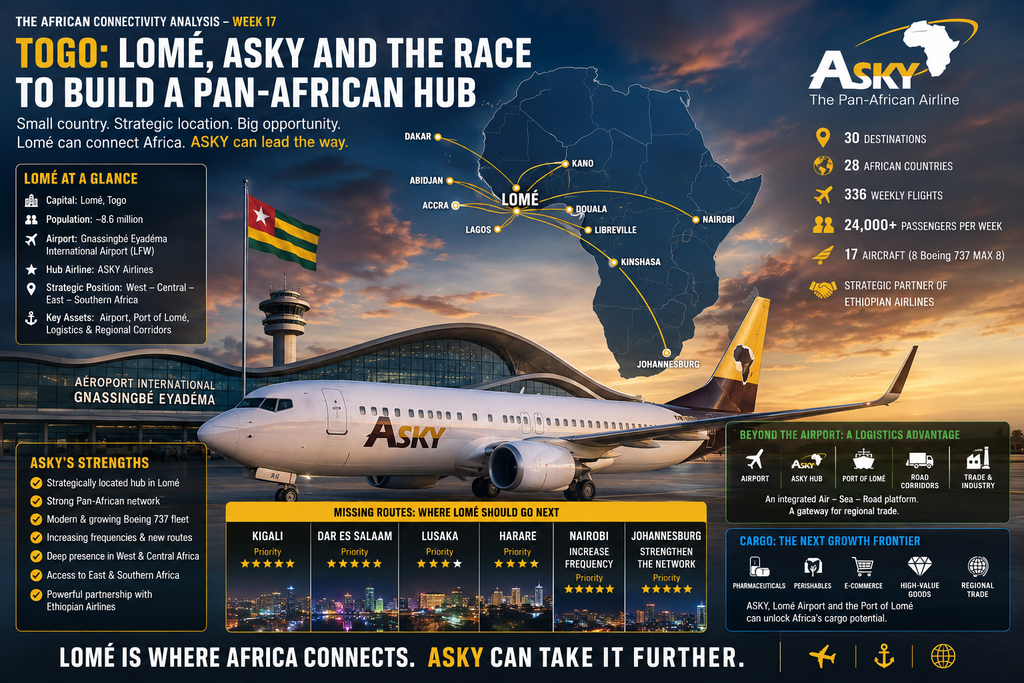
The airline currently connects 30 destinations across 28 African countries, with 336 weekly flights and approximately 24,000 passengers per week, according to its published network information.
ASKY’s official network information
Those numbers matter—but the more important story is what sits behind them.
ASKY has built a network designed around Lomé rather than around the size of the Togolese market.
That is a fundamentally different aviation strategy.
Its opportunity is to make Lomé a place where passengers from West Africa can efficiently reach Central, East and Southern Africa—and vice versa.
In other words:
ASKY does not need Togo to be a huge market.
It needs Lomé to be an efficient connecting point.
🛫 The Fleet Is Sending a Message
ASKY is also investing in the capacity required to support that ambition.
In July 2026, the airline added two new Boeing 737 MAX 8 aircraft, bringing its fleet to 17 aircraft, including eight 737 MAX 8s.
The new aircraft have a 160-seat configuration: 16 Business Class and 144 Economy Class seats. ASKY says the additional capacity will support increased frequencies and new markets. (flyasky.com)
This is important because successful hubs are not created simply by adding destinations.
They are created through capacity, frequency, schedule reliability and connectivity.
A passenger is far more likely to connect through Lomé if the schedule works.
That is where the next phase of ASKY’s growth becomes particularly interesting.
🌍 The Real Opportunity: Build Depth, Not Just Breadth
ASKY already has a meaningful Pan-African footprint.
The next challenge should not simply be:
“Where else can we fly?”
It should be:
“How can we make Lomé more useful to passengers?”
That means stronger connection banks, better schedule coordination and greater frequency on strategically important markets.
Markets such as:
Abidjan
Accra
Lagos
Abuja
Dakar
Bamako
Douala
Libreville
Nairobi
Johannesburg
should be viewed not only as destinations, but as building blocks of a connecting network.
The objective should be simple:
A smaller network with strong connectivity can be more powerful than a larger network with weak connections.
🟢 Where Could ASKY Go Next?
This is where I believe the strategic conversation becomes interesting.
Rather than simply adding destinations, ASKY could selectively strengthen the links between West Africa and regions where Lomé still has room to grow.
🇷🇼 Lomé – Kigali
Kigali could strengthen the West Africa–East Africa connection and give ASKY another important gateway into the Great Lakes region.
The value would not only be the local Kigali market.
It would be the network created around it.
🇹🇿 Lomé – Dar es Salaam
Dar es Salaam could provide an additional bridge into Tanzania and the Indian Ocean region.
It would also create potential opportunities around trade, tourism, business and regional mobility.
🇿🇲 Lomé – Lusaka
Lusaka could strengthen ASKY’s Southern African network and provide access to Zambia and surrounding markets.
🇿🇼 Lomé – Harare
Harare could provide another Southern African gateway and diversify the network beyond Johannesburg.
These should not be viewed as routes ASKY must launch.
They are strategic possibilities worth evaluating against demand, connectivity, aircraft utilisation and commercial viability.
🇰🇪 Nairobi and 🇿🇦 Johannesburg: Depth Matters
Two markets deserve particular attention: Nairobi and Johannesburg.
They are not simply destinations.
They can become network anchors.
The opportunity is therefore not necessarily to add more cities immediately.
It may be to strengthen the existing network around these gateways through better frequencies and connection timing.
That is how a hub becomes useful.
More destinations create headlines.
Better connections create passengers.
🤝 Ethiopian Airlines: A Strategic Advantage
There is another important piece of the puzzle: Ethiopian Airlines.
ASKY does not need to duplicate every long-haul or African connection operated through Addis Ababa.
There is a much more interesting strategy:
ASKY → connect Africa
Ethiopian → connect Africa with the world
That creates a complementary network rather than a competing one.
If managed effectively, the relationship can give Lomé access to a much wider global aviation ecosystem while allowing ASKY to focus on its core strength: intra-African connectivity.
🚢 Lomé’s Opportunity Goes Beyond Passengers
The aviation story also needs to be viewed alongside the Port of Lomé.
Lomé has the ingredients to develop a broader multimodal platform:
✈️ Airport
🛫 ASKY hub
🚢 Port
🚚 Regional road connectivity
🏭 Trade and industrial activity
That creates an opportunity to think beyond:
“How many passengers can Lomé attract?”
and towards:
“How much regional economic activity can Lomé connect?”
That is a much bigger question.
📦 Cargo Could Become the Next Chapter
Passenger connectivity is only one part of the opportunity.
ASKY itself notes that it does not operate a dedicated cargo aircraft and currently handles cargo through passenger operations.
That limitation can also become an opportunity.
As Lomé’s passenger network develops, there is potential to strengthen cargo flows around sectors such as:
- Pharmaceuticals
- Perishables
- E-commerce
- High-value goods
- Regional trade
The combination of an expanding airline network, airport infrastructure and the Port of Lomé creates the possibility of developing a more integrated air–sea–road logistics platform.
That could eventually make Lomé relevant not only to passengers, but also to trade.
📊 My Strategic Assessment
| Area | Assessment |
| Lomé hub potential | ⭐⭐⭐⭐⭐ |
| ASKY network | ⭐⭐⭐⭐⭐ |
| Intra-African connectivity | ⭐⭐⭐⭐⭐ |
| Fleet development | ⭐⭐⭐⭐⭐ |
| East African opportunity | ⭐⭐⭐⭐⭐ |
| Southern African opportunity | ⭐⭐⭐⭐☆ |
| Cargo opportunity | ⭐⭐⭐⭐☆ |
| Multimodal logistics potential | ⭐⭐⭐⭐⭐ |
| Overall strategic potential | ⭐⭐⭐⭐⭐ |
These are strategic assessments, not official ratings.
💡 The Bigger Picture
Togo does not need to become Africa’s biggest aviation market.
It needs to become one of its best connected.
And ASKY has already built something that many African countries have struggled to create: a genuinely Pan-African network centred on a relatively small home market.
The next stage will be more difficult.
It will require:
Better connection banks.
More frequency on core markets.
Selective expansion into strategically important regions.
Stronger commercial partnerships.
More effective cargo development.
Closer integration between aviation and logistics.
And, above all, discipline in network development.
Because the future of Lomé will not be determined by how many destinations appear on a route map.
It will be determined by how useful that route map becomes to the people and businesses moving across Africa.
That is the real opportunity.
My view
Lomé does not need to become Africa’s biggest hub.
It could become something more practical:
One of Africa’s most efficient places to connect Africa.
And if ASKY can turn its existing network, fleet investment and strategic partnerships into consistently strong connections, Lomé could become one of the continent’s most important regional aviation platforms.
The interesting question for the next few years is therefore not:
“Can ASKY grow?”
It is:
“Can ASKY turn growth into a genuinely powerful African network?”
That is where the real competition for Africa’s next generation of aviation hubs will be decided.
What do you think? Can Lomé challenge Africa’s established hubs for intra-African connectivity? And which routes should ASKY prioritise next?
#Aviation #AfricaAviation #AfricanConnectivity #ASKY #Togo #Lome #AviationStrategy #RouteDevelopment #WestAfrica #EastAfrica #SouthernAfrica #AfCFTA #SAATM #AfricanAviation