

Can Douala Become Central Africa’s Connecting Gateway?
Cameroon already has the routes.
So why isn’t Douala functioning as a stronger regional connecting hub?
That is the question I explored in Week 19 of my African Connectivity Analysis.
Cameroon has many of the ingredients required for a regional aviation gateway: a large domestic market, the largest economy in CEMAC, a strategic geographic position, access to the Atlantic, established connections across Africa and Europe, and a significant logistics ecosystem.
But there is an important distinction:
Cameroon has connectivity. What it lacks is connectivity depth.
Douala already has a strong foundation
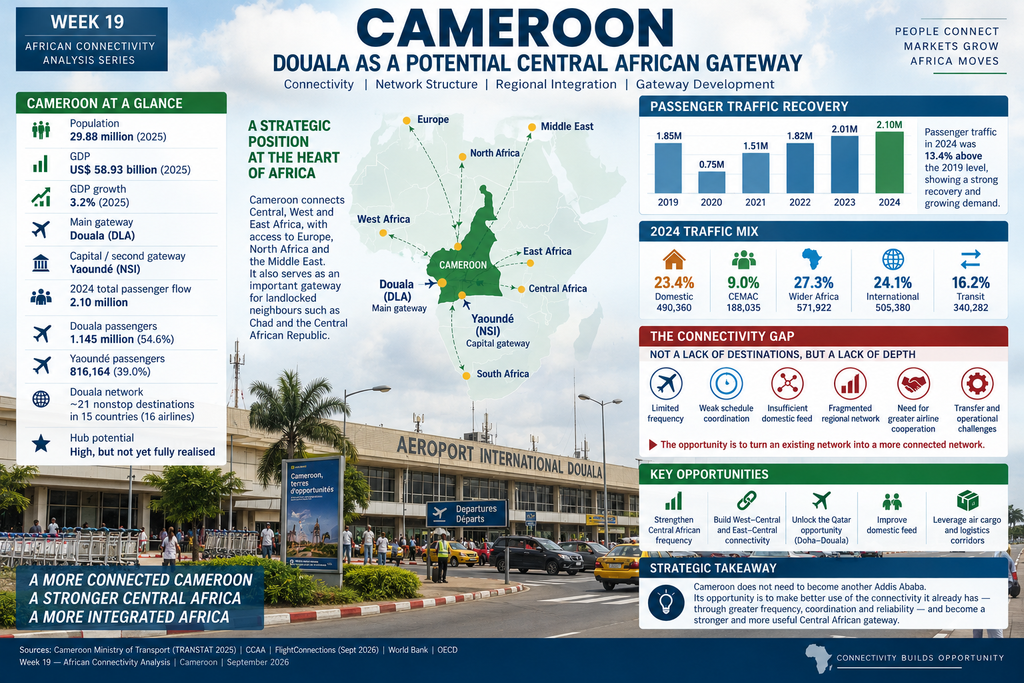
The numbers are compelling.
In 2024, Douala handled approximately 1.145 million passengers, while Yaoundé handled 816,164.
Together, the two airports accounted for approximately 93.6% of the passenger traffic reported across Cameroon’s principal airports.
Douala’s current network is also geographically diverse, connecting with markets across:
✈️ Central Africa
✈️ West Africa
✈️ East Africa
✈️ Europe
✈️ North Africa
September 2026 schedule data show approximately 21 nonstop passenger destinations across 15 countries from Douala.
So the question is no longer simply:
“Where else can Douala fly?”
The more important question is:
“How can Douala make the network it already has work better?”
The real opportunity is bigger than CEMAC
One of the most interesting findings in the data is the composition of Cameroon’s traffic.
In 2024:
- CEMAC traffic: 188,035 passengers
- Wider regional African traffic: 571,922 passengers
Wider regional African traffic was therefore almost three times the CEMAC figure.
This tells us that Cameroon’s aviation opportunity should not be viewed only through a CEMAC lens.
Douala could potentially become a bridge between two major African sub-regions:
WEST AFRICA ↔ DOUALA ↔ CENTRAL AFRICA
And, with the right schedule structure:
EAST AFRICA ↔ DOUALA ↔ CENTRAL AFRICA
That is a much more interesting proposition than simply adding isolated routes.
The connectivity gap
In my view, the biggest mistake would be to measure Douala’s potential only by the number of destinations on a route map.
A route is not necessarily connectivity.
A flight can exist and still provide limited connecting value if:
- it operates only a few times per week;
- arrival and departure times do not align;
- domestic feed is weak;
- transfer processes are inefficient;
- delays regularly break connection windows; or
- airlines operate independently without commercial cooperation.
This is what I would call the network-depth gap.
And this is where I believe the next phase of Cameroon’s aviation development should focus.
Three questions should be asked for every potential new route:
Demand → Frequency → Connectivity
Does the demand exist?
Can the route operate with sufficient frequency?
And, most importantly, does the schedule connect effectively with the wider network?
Adding five destinations to the map without addressing these questions may create a bigger network on paper without creating a stronger hub in reality.
What could make the difference?
1️⃣ Frequency
A route operating two or three times a week is very different from one that gives passengers multiple useful connection opportunities.
2️⃣ Schedule coordination
The objective should be to create practical connecting waves rather than simply having flights arriving and departing throughout the day.
3️⃣ Domestic feed
A regional gateway needs passengers from its own country.
Douala’s potential therefore depends partly on connecting secondary Cameroonian cities into the international network at useful times.
4️⃣ Airline cooperation
Codeshares, interlines and coordinated schedules can turn separate airline operations into a genuine network.
5️⃣ Transfer experience
Passengers need to be able to move through the airport reliably and predictably.
6️⃣ Cargo
Douala already handles approximately 69% of Cameroon’s national air cargo, reinforcing its position as a broader logistics gateway.
The passenger and cargo strategies should therefore be considered together.
What about Doha?
The Cameroon–Qatar Air Transport Agreement ratified in January 2026 is strategically interesting.
It creates a regulatory framework for direct services, and direct Doha–Douala services were expected to follow.
However, as of my September 2026 research position, Doha–Douala does not appear as an active nonstop scheduled service.
So I would classify Doha as an enabling development and future connectivity opportunity, rather than an existing route.
If launched, it could add another major global gateway and strengthen one-stop connectivity between Central Africa, the Gulf and Asia.
Yaoundé also matters
Cameroon should not be viewed as a single-airport market.
Douala is clearly the dominant commercial gateway, but Yaoundé has an important role as the political and institutional capital and as a second international gateway.
There is also a personal lesson here from my own aviation experience.
In 2015, I was directly involved in opening the Yaoundé route for Ethiopian Airlines.
The service initially operated three times per week.
Within 14 months, strong underlying demand helped the market develop into a daily operation.
For me, this remains a useful reminder that:
Frequency can create market development — when the underlying demand is there and the market is properly cultivated.
So, can Douala become a regional hub?
Yes — potentially. But not automatically.
Cameroon already has many of the assets:
Geography
Market size
Traffic concentration
Regional connectivity
International links
Logistics infrastructure
The missing ingredient is the ability to connect these assets into one functioning network.
That means the strategic priority should not necessarily be:
“How many new routes can Cameroon add?”
It should be:
“Which existing connections can be made frequent, reliable and coordinated enough to change how Central Africa moves?”
That, in my view, is the real opportunity for Douala.
And perhaps the most important point from Week 19 is this:
Douala does not need to create a Central African network from scratch.
It needs to turn the network it already has into a deeper, more reliable and better-connected system.
That is where the next level of African aviation connectivity could come from.
Week 19 — African Connectivity Analysis | Cameroon | September 2026
Sources: Cameroon Ministry of Transport TRANSTAT 2025; Cameroon Civil Aviation Authority (CCAA); September 2026 schedule snapshots; World Bank/OECD. Passenger and airport figures follow the definitions used in the underlying source publications.
#AfricanAviation #AviationConnectivity #Cameroon #Douala #CentralAfrica #AfricanAviation #AirlineStrategy #Connectivity #AviationLeadership #Week19