

DEMOCRATIC REPUBLIC OF THE CONGO
Kinshasa and Lubumbashi: Can the DRC Turn Its Size into Better Air Connectivity?
The Democratic Republic of the Congo is one of the most difficult aviation markets in Africa to assess.
The country has a population of more than 110 million, a very large geographical area and an economy increasingly driven by mining and international trade. Yet its aviation network remains relatively small for a market of this size.
IATA’s latest connectivity snapshot shows that the number of scheduled routes in the DRC fell from 108 in 2015 to 79 in 2025. Seventy percent of those routes carried fewer than 20,000 seats a year. At the same time, 93% of the country’s airports with scheduled services were classified as regional airports.
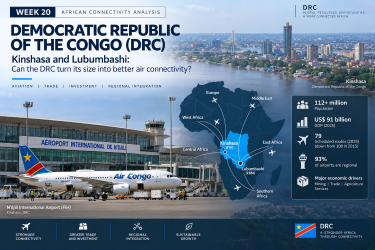
These figures explain much of the problem.
The DRC does not lack potential passengers. The difficulty is connecting a very large and geographically dispersed market in a way that is frequent enough, reliable enough and commercially sustainable for airlines.
Kinshasa and Lubumbashi are at the centre of this discussion.
Kinshasa is the country’s main international gateway and the natural centre for connections to West and Central Africa, Europe and the Middle East. Lubumbashi plays a different role. Its economy is closely linked to mining and the Copperbelt, making it particularly relevant to Southern and Eastern Africa.
The two airports should therefore not necessarily be viewed as competitors. A stronger DRC network could use Kinshasa and Lubumbashi for different purposes, while improving the links between them and the country’s secondary cities.
That is where I believe the real connectivity opportunity lies.1. The DRC Market
| Indicator | Current position |
|---|---|
| Population | 112+ million |
| Main gateway | Kinshasa N’Djili (FIH) |
| Second gateway | Lubumbashi (FBM) |
| Other important markets | Goma, Kisangani, Mbuji-Mayi, Kolwezi, Kananga, Kalemie |
| Main economic drivers | Mining, trade, agriculture, services |
| Main aviation challenge | Large geography + thin regional demand |
| Main opportunity | Building stronger domestic and regional links |
The DRC’s size makes domestic aviation particularly important. Road and rail cannot provide the same level of mobility across the country, particularly when travel involves Kinshasa and the eastern or southern parts of the country.
This creates a relatively unusual situation: aviation is not simply a convenience in the DRC; for many markets it is part of the country’s basic economic connectivity.
2. Kinshasa
Kinshasa remains the obvious international gateway.
The airport has benefited from significant investment in recent years. The African Development Bank says approximately US$105 million has supported improvements under the Priority Aviation Safety Project, including air-navigation systems, surveillance, communications, fire services and power infrastructure. The project has also supported improvements at Kisangani, Kindu and Mbuji-Mayi.
This is important because the infrastructure question at Kinshasa is beginning to look different from a few years ago.
The bigger question now is whether the network using that infrastructure can grow with it.
Kinshasa already has connections with major African hubs including Addis Ababa, Nairobi and Johannesburg, together with European, Middle Eastern and regional African services.
But there are still obvious gaps.
For example, Kinshasa–Lagos is the type of market that deserves closer attention. Two of Africa’s largest commercial centres remain without a strong direct connection, leaving passengers dependent on other African hubs.
The same applies to several West and Central African markets where the demand may not justify daily widebody operations but could potentially support a properly structured narrowbody service.
3. Lubumbashi Is Different
Lubumbashi should be analysed separately from Kinshasa.
Its importance comes largely from the mining economy and its geographical position close to Zambia and the wider Southern African network.
The city already has direct links to important regional centres. The Kinshasa–Lubumbashi market itself is relatively strong: September 2026 schedules show more than 25 weekly nonstop flights, with Ethiopian Airlines and flyCAA among the operators.
This is significant.
The route is not simply a domestic trunk. It can become the backbone of a wider two-gateway system.
A passenger travelling from Johannesburg, Nairobi or Dar es Salaam should ideally be able to reach Lubumbashi and then connect efficiently into the wider DRC network.
Equally, passengers originating in cities such as Goma, Kisangani or Mbuji-Mayi should be able to reach the country’s main international gateways without unnecessarily long or unreliable connections.
4. Air Congo Could Change the Picture
One of the most important developments in the DRC market is the development of Air Congo, supported by Ethiopian Airlines.
The carrier is expanding beyond its initial domestic network. Its 2026 schedule development includes services involving Douala, Cotonou, Entebbe, Dar es Salaam and Johannesburg, with several services routed through Kinshasa or Lubumbashi.
I think this is more important than simply adding another airline to the DRC market.
If Air Congo can build a reliable domestic network and then use it to feed regional routes, it could begin addressing one of the DRC’s biggest weaknesses: the lack of a carrier capable of connecting the country’s different economic regions into one network.
But this will require discipline.
The airline should not expand simply because traffic rights or geographic opportunities exist. Each route needs sufficient demand, appropriate aircraft, realistic frequencies and, where necessary, connecting traffic.
5. Where Are the Real Gaps?
For me, the most interesting opportunities are not necessarily the longest routes.
They are the routes where the DRC is economically important but passengers still have to make unnecessary connections.
| Route / market | My assessment |
|---|---|
| Kinshasa–Lagos | High potential |
| Kinshasa–Accra | High potential |
| Kinshasa–Douala | High potential |
| Kinshasa–Nairobi | Strengthen existing connectivity |
| Kinshasa–Johannesburg | Strengthen frequency/feed |
| Lubumbashi–Lusaka | Important Copperbelt connection |
| Lubumbashi–Dar es Salaam | Strategically important |
| Kinshasa–Dubai | Worth detailed commercial evaluation |
| Kinshasa–secondary DRC cities | Very important for national connectivity |
I would be particularly interested in Kinshasa–Lagos and Kinshasa–Douala.
These are the types of routes where connectivity can support business activity rather than simply adding another destination to a route map.
6. Kinshasa–Dubai
This deserves a separate look.
There is no current nonstop Kinshasa–Dubai service, despite the importance of Dubai to African trade, finance, logistics and mining.
Airbus has previously identified Kinshasa–Dubai among significant unserved Sub-Saharan African city pairs.
The opportunity should nevertheless be tested carefully.
A successful route would need more than local Kinshasa–Dubai passengers. The business case could potentially combine:
- DRC business traffic
- Mining-related travel
- Cargo
- Government travel
- Diaspora
- Onward connections through Dubai
This is exactly where a proper O&D and connecting-traffic analysis is required before recommending a route.
7. Cargo Is an Important Part of the Story
It would be a mistake to look at DRC connectivity only from the passenger side.
The country’s mining sector creates demand for time-sensitive movement of:
- Equipment and spare parts
- Technical personnel
- High-value components
- Samples
- Pharmaceuticals
- Specialist cargo
Lubumbashi and the wider Copperbelt are particularly relevant.
The opportunity may not initially be a dedicated freighter network. A more realistic starting point could be better belly-cargo connectivity on passenger services, supported by reliable schedules and appropriate handling facilities.
8. What Still Needs to Improve?
There are several issues that cannot be solved simply by putting more aircraft into the market.
First, frequency.
A route operated once or twice a week may technically provide connectivity but does not necessarily create a useful business route.
Second, domestic feed.
Kinshasa and Lubumbashi need stronger links with the secondary cities.
Third, reliability.
For business and connecting passengers, a route is only valuable when the schedule can be trusted.
Fourth, regulation and safety oversight.
Infrastructure has improved, but regulatory credibility remains important for attracting more international operators.
Fifth, commercial cooperation.
Interline agreements, codeshares and coordinated schedules could make the existing network much more useful without requiring every market to have a new nonstop flight.
9. My View of the Opportunity
I would not recommend trying to turn Kinshasa into another Addis Ababa.
The DRC has a different geography and a different commercial structure.
Instead, I see an opportunity for a two-gateway system:
KINSHASA
West Africa • Central Africa • Europe • Middle East
LUBUMBASHI
Southern Africa • East Africa • Mining/Copperbelt
And between them, a strong domestic network supported by Air Congo and other operators.
That would give the DRC something it currently lacks: a coherent national network rather than a collection of individual routes.
DRC Connectivity Scorecard
| Area | Assessment |
|---|---|
| Market potential | Very Strong |
| International connectivity | Strong |
| Regional African connectivity | Moderate |
| Domestic connectivity | Weak/Moderate |
| Lubumbashi opportunity | Very Strong |
| Cargo opportunity | Very Strong |
| Airport infrastructure | Improving |
| Airline development | Improving |
| Regulatory environment | Needs further improvement |
| Hub potential | High |
| Route-development opportunity | High |
Final Takeaway
The DRC is probably one of the clearest examples in Africa where economic potential and aviation connectivity are not yet moving at the same speed.
The country has the population, geography, mining activity and regional importance to support a much stronger aviation network.
The encouraging part is that some of the foundations are now improving. N’Djili has undergone important modernization, Air Congo is developing its network, and several regional routes are being added or strengthened.
The next step should be more selective.
Rather than asking how many destinations the DRC can add, I would focus on a smaller number of commercially meaningful connections and make them work properly.
Kinshasa–Lagos.
Kinshasa–Douala.
Kinshasa–Dubai.
Lubumbashi–Nairobi.
Lubumbashi–Lusaka.
And stronger links between Kinshasa, Lubumbashi and the secondary DRC cities.
If these connections can be developed with the right frequency, aircraft, traffic rights and commercial partnerships, the DRC could become much better connected to the rest of Africa.