

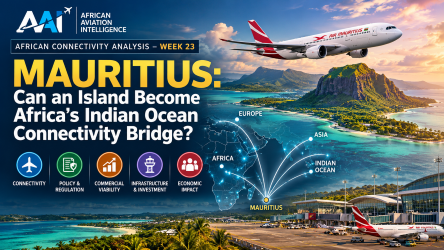
🇲🇺 Mauritius: Can an Island Become Africa’s Indian Ocean Connectivity Bridge?
A commercial and strategic assessment of connectivity, policy, route economics, infrastructure and economic impact
🇲🇺 MAURITIUS AT A GLANCE
| Indicator | Latest verified figure / assessment |
| Region | Indian Ocean / Southern Africa |
| Capital | Port Louis |
| Population | 1,241,856 at end-2025 |
| Primary international gateway | Sir Seewoosagur Ramgoolam International Airport (MRU) |
| National carrier | Air Mauritius |
| Tourist arrivals, 2025 | 1,436,250 |
| Arrivals by air, 2025 | 1,411,791 (98.3% of total arrivals) |
| Regular scheduled routes, 2025 | 30 (IATA regional connectivity snapshot) |
| Airlines in the market, 2025 | 22 |
| Low-volume routes, 2025 | 15 of 30 routes had fewer than 20,000 seats annually |
| Bilateral air-services agreements | 60 concluded; 35 signed |
| Air Mauritius network | 13 direct destinations; 70+ destinations through codeshare partners |
| Strategic role | Indian Ocean gateway linking Mauritius with Africa, Europe, Asia and other global markets |
Introduction
Mauritius is one of Africa’s most unusual aviation markets. It is geographically small, far from the continent’s largest population centres, and heavily dependent on international air access. Yet it has built a sophisticated aviation ecosystem around tourism, international business and its position in the Indian Ocean.
The numbers show why connectivity matters so much. Mauritius recorded 1,436,250 tourist arrivals in 2025, up 3.9% from 2024. Of these, 1,411,791 arrived by air — about 98.3% of the total. In other words, aviation is not simply supporting Mauritius’s tourism economy; it is the infrastructure through which the tourism economy reaches the island.
But Mauritius should not measure its aviation success only by the number of international destinations it can reach. The more strategic question is whether it can convert strong global connectivity into deeper, commercially sustainable connectivity with Africa.
1. CONNECTIVITY
Mauritius has strong long-haul connectivity relative to the size of its domestic market. Air Mauritius currently advertises direct service to 13 destinations and connectivity to more than 70 destinations through codeshare partners. Its 2026 network connects the island with major markets in Europe, Southern Africa, India, the Middle East, Southeast Asia and Australia.
The 2025 IATA connectivity snapshot, however, provides an important warning. Mauritius had 30 regular scheduled routes in 2025, compared with 35 in 2015 — a 14% decline. At the same time, the number of airlines serving the market increased from 16 to 22. The lesson is that more airline brands do not automatically mean a stronger or deeper network.
IATA also found that 15 of Mauritius’s 30 routes in 2025 carried fewer than 20,000 seats annually. That threshold is useful because it illustrates how many routes operate at relatively thin volumes. It also reinforces an important AAI principle: route count alone is not enough. Frequency, aircraft size, schedule quality, transfer opportunities and route economics determine whether connectivity is actually useful.
Connectivity Gap — where Mauritius could connect next
Mauritius’s principal connectivity gap is not a lack of access to the world. It is the relatively thin number of direct links to important African economic centres outside its existing Southern African and Indian Ocean network.
The following are strategic opportunities for further commercial testing. They are recommendations, not assertions that sufficient demand has already been proven. Before launch, each should be validated through O&D data, fare levels, seasonality, cargo potential, bilateral traffic rights and a realistic break-even assessment.
| Potential route | Current gap | Aircraft / frequency concept | Approx. distance | Why it matters |
| MRU–Dar es Salaam (DAR) | No current nonstop service identified | E190/E195-E2 or A220-100/300; initially 2–3 weekly | Approx. 2,500 km | Dar es Salaam would give Mauritius a direct link to one of East Africa’s largest commercial centres and a gateway into Tanzania. Current journeys require a connection, with options through Mahé, Nairobi, Addis Ababa or Johannesburg. A nonstop service could reduce travel friction for business, tourism and Indian Ocean–East Africa trade. The route is short enough for a right-sized regional jet, making a frequency-led test more logical than a large widebody. |
| MRU–Lusaka (LUN) | No current nonstop service identified | E195-E2 / A220-300; initially 2–3 weekly | Approx. 3,144 km | Lusaka would strengthen Mauritius’s connection with the Southern-Central African business corridor. Current itineraries commonly route via Johannesburg, Nairobi or Addis Ababa. A direct service could improve access for business, tourism and regional trade while creating a potential onward network opportunity into Zambia and neighbouring markets. |
| MRU–Maputo (MPM) | No current nonstop service identified | E195-E2 / A220-300; initially 2–3 weekly | Approx. 2,637 km | Maputo is geographically close enough to make a right-sized aircraft strategy credible. The opportunity is especially interesting because Mauritius and Mozambique sit within the broader Indian Ocean/Southern African economic space, yet passengers currently connect through other hubs. A nonstop link could support business, investment, tourism and stronger two-way commercial links. |
| MRU–Lagos (LOS) | No current nonstop service identified | A321LR/XLR or similar long-range narrowbody; initially 2 weekly | Approx. 6,661 km | Lagos would be a higher-risk but strategically significant opportunity. Nigeria is Africa’s largest population market and one of its most important business centres, while Mauritius is a major tourism and international-business gateway. Today the journey normally requires a connection. A nonstop service would create a new West Africa–Indian Ocean corridor and potentially open one-stop opportunities beyond Lagos. The distance, however, means this should be tested with a long-range narrowbody and conservative frequency rather than a large widebody. |
| MRU–Accra (ACC) | No current nonstop service identified | A321LR/XLR or similar long-range narrowbody; initially 2 weekly | Approx. 6,954 km | Accra would provide Mauritius with a second potential West African gateway and diversify its African network beyond the Southern/East African axis. The case would depend heavily on premium/business demand, tourism flows, cargo and connecting traffic. It is therefore a longer-term opportunity rather than the first route to launch. |
priority view: Dar es Salaam, Lusaka and Maputo are the more natural first-stage candidates for a right-sized regional-jet strategy because of their distance from Mauritius. Lagos and Accra are strategically attractive but materially longer and therefore require stronger demand validation and long-range narrowbody economics. The objective should not be to add five routes at once. It should be to identify one or two routes capable of reaching sustainable frequency and then build from there.
2. POLICY & REGULATION
Mauritius has taken a gradual approach to air-service liberalisation. The government reports that it has concluded bilateral air-services agreements with 60 countries, of which 35 have been signed. These agreements establish the framework for traffic rights, airline designation, capacity, tariffs, competition policy and safety and security requirements.
The policy direction is therefore not simply ‘open the market’. Mauritius is trying to expand international connectivity while protecting the conditions for Air Mauritius to remain commercially viable. That balance matters because an open market without sustainable capacity can produce temporary connectivity rather than a durable network.
The government also reported applications from six new foreign airlines between March 2024 and October 2026, including Ethiopian Airlines and Airlink. Ethiopian subsequently launched Addis Ababa–Mauritius service in July 2026, three times weekly with the Boeing 787-8. This is a meaningful addition because it connects Mauritius directly to a major African hub and its wider global network.
3. COMMERCIAL VIABILITY
Mauritius has a relatively unusual commercial aviation profile: the local population is only about 1.24 million, while annual tourist arrivals exceed the resident population. This makes external demand — tourism, visiting friends and relatives, business travel, investment and connecting traffic — central to route economics.
In 2025, Mauritius received 1,436,250 tourists. India was the standout growth market among the main source markets, rising 33.5% to 75,808 arrivals. In the first half of 2026, India increased another 11.9% year on year to 41,966 arrivals, while South Africa grew 7.1% to 51,858 and Germany grew 13.4% to 60,227.
These figures point to a wider commercial lesson: Mauritius should pursue connectivity where demand can support frequency, not simply where a route looks attractive on a map. For African routes, that means combining passenger O&D demand with corporate travel, tourism, cargo, VFR traffic and — where appropriate — connecting flows.
The strongest network strategy may therefore be a portfolio of right-sized aircraft and carefully selected frequencies rather than trying to replicate a large continental hub model.
4. INFRASTRUCTURE & INVESTMENT
Sir Seewoosagur Ramgoolam International Airport has the infrastructure to support Mauritius’s role as an international gateway. Airports of Mauritius reports a 3,040-metre by 75-metre runway, a 57,000 m² terminal, eight passenger bridges and 16 aircraft parking stands on the main apron.
The airport handled 3,686,624 international passengers in 2019, before the pandemic disruption, and 3,884,056 passengers in total that year. This provides useful evidence of the scale that the gateway has previously supported.
The investment question is therefore not simply whether Mauritius needs a bigger airport. It is whether infrastructure, airline capacity, ground handling, cargo facilities and schedule coordination can support a more diversified network without undermining operational reliability.
Resilience also matters. In 2026, Air Mauritius added supplementary Paris services to respond to demand and maintain connectivity during a period of international aviation disruption. That illustrates the value of having network flexibility rather than relying on a rigid schedule.
5. ECONOMIC IMPACT
Mauritius demonstrates why aviation connectivity should be viewed as economic infrastructure. In 2025, the country recorded 1,436,250 tourist arrivals and GDP growth of 3.2% under the then-current national accounts series. In the revised national accounts framework published in September 2026, the 2025 GDP growth rate was subsequently revised to 3.5%.
The revised 2026 national accounts also show the continued importance of transport and tourism-linked activities. Accommodation and food service activities accounted for 6.9% of GVA in 2025, while transportation and storage accounted for 6.4%. These figures do not mean aviation alone created these sectors, but they demonstrate the scale of the economic ecosystem that depends on movement, visitors and logistics.
For Mauritius, better African connectivity could therefore have effects beyond passenger numbers: more business links, more investment access, stronger tourism diversification, greater trade connectivity and additional opportunities to position the island as a gateway between African markets and the Indian Ocean.
My Assessment: Mauritius’s Connectivity Gap
Mauritius does not have a simple connectivity problem. It has a connectivity-structure problem.
The island is already well connected to major global markets. Its weakness is that African connectivity remains concentrated in a relatively small number of corridors. Air Mauritius has strong Southern African and Indian Ocean links, codeshare access through partners, and Mauritius now has a direct Ethiopian Airlines connection to Addis Ababa. But important African commercial centres such as Dar es Salaam, Lusaka, Maputo, Lagos and Accra remain without nonstop links from Mauritius.
The strategic opportunity is not to chase every unserved city. It is to identify the markets where a direct link can create enough combined demand to support sustainable economics.
That is why I recommends a staged approach: first test shorter East and Southern African markets with right-sized aircraft; then consider longer West African links only where the commercial evidence supports a long-range narrowbody. The aircraft should follow the market — not the other way around.
The Bigger African Aviation Lesson
Mauritius offers a lesson that applies well beyond the island.
Aviation strategy is not always about becoming the biggest hub. Sometimes it is about becoming the right gateway for a specific geography and economic model.
For Mauritius, that means using its Indian Ocean position, tourism strength, international-business ecosystem and existing airline partnerships to build a more balanced African network. The most valuable new route may not be the one with the largest aircraft. It may be the one that is operated frequently enough, with the right aircraft, at the right cost, to become sustainable.
Conclusion
Mauritius has already built something valuable: an aviation system that connects a small island economy to global markets at a scale far beyond its domestic population.
The next phase should be about depth rather than simply breadth.
If Mauritius can strengthen commercially viable African links, use air-service liberalisation strategically, deploy right-sized aircraft and deepen its partnership network, it can move from being an island that is connected to the world to becoming a more important connector between Africa, the Indian Ocean and Asia.
Strategic Takeaway
Mauritius does not need to become Africa’s biggest aviation hub. Its opportunity is to become one of Africa’s most strategically connected gateways to the Indian Ocean and Asian markets.
Key Sources — verified for this edition
- Statistics Mauritius — International Travel and Tourism, Year 2025.
- Statistics Mauritius — International Travel and Tourism, First Semester 2026.
- Statistics Mauritius — Population and Vital Statistics, Year 2025; January–June 2026.
- IATA — Regional Air Connectivity in Mauritius: A 2025 Snapshot.
- Government of Mauritius / Prime Minister’s Office — Air-services liberalisation and bilateral air-services agreements.
- Air Mauritius — Route Network; Summer Timetable 2026; April 2026 Route Map; 2026 Paris connectivity update.
- Airports of Mauritius — SSR International Airport Facts & Figures and passenger statistics.
- Statistics Mauritius — National Accounts, September 2026 revised series.
- Ethiopian Airlines — Launch of Addis Ababa–Mauritius service, July 2026.
- FlightConnections — current route availability and distances used only to validate the stated absence of nonstop service and approximate city-pair distances. These route proposals remain AAI recommendations requiring commercial validation.
Africa Aviation Intelligence (AAI) | African Connectivity Analysis — Week 23