

Angola: An Emerging Aviation Gateway in Southern and Central Africa
Before we dive into this week’s breakdown, a quick shout-out to everyone who engaged with last week’s analysis. If you missed it, we evaluated Kenya’s incredible transit hub dynamics and strategic network advantages. You can find that report on my profile to see how East Africa’s primary gateway compares with the market we are uncovering today!
This week, my focus shifts across the continent to Angola—one of Africa’s most strategically positioned, fast-evolving, and high-yield aviation markets.
With massive capital investments in brand-new mega-infrastructure, a booming resource sector, and tightening regional ties, Angola is actively repositioning itself to connect Southern, Central, and West Africa.
Drawing on publicly available data and my 15+ years of experience across airline operations, airport management, and charter coordination with Ethiopian Airlines and the IOM, here is my operational take on Angola’s current landscape, major growth sectors, and practical hurdles.
Country Overview: A Demographic and Resource Powerhouse
Angola is a geographic and economic heavyweight. Its population has officially surpassed 40.2 million, driven by an incredibly young median age and a rapidly expanding urban middle class centered in Luanda, which has over 11 million residents.
This vast population base, paired with massive reserves of oil, natural gas, diamonds, and critical minerals, creates a highly unique, structural demand for both high-yield passenger travel and heavy cargo transport. In a country with massive distances and challenging terrain, air connectivity isn’t a luxury—it’s a vital economic conveyor belt.
The core sectors moving the needle:
- Energy: Offshore oil, gas, and maritime logistics (massive crew rotations).
- Extractives: Diamond and mineral mining logistics in remote provinces.
- Humanitarian and Development: NGO, UN, and cross-border operations.
- Leisure: An untouched, high-potential eco-tourism market.
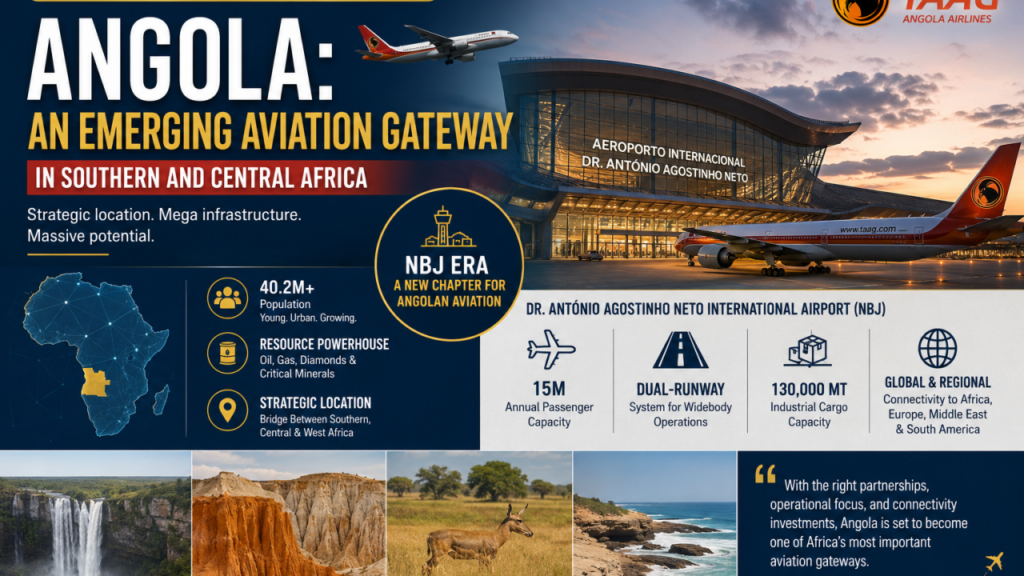
Infrastructure: The Dawn of the NBJ Era
You cannot talk about Angolan aviation without talking about the new Dr. António Agostinho Neto International Airport (IATA: NBJ). This US$3.8 billion mega-project completely changes the regional playing field.
Following a major phased transition, TAAG Angola Airlines fully consolidated its entire domestic and international operations at NBJ, with foreign legacy carriers completing their relocation over the recent months. The sheer scale of this asset is highly impressive:
- 15 Million Annual Passenger Capacity: Perfectly sized to handle the country’s macro growth.
- Dual-Runway System: Parallel runways built to handle widebodies like B777s, B787s, and A350s with zero effort.
- Industrial Cargo Terminal: Ready for 130,000 metric tons of freight annually, a perfect fit for heavy industrial supply chains.
The Vital Domestic Feed
A mega-hub is only as strong as its feeder network. Angola relies heavily on a critical domestic spine to keep its economy moving:
- Cabinda: High-volume oil enclave shuttle traffic (geographically separated).
- Soyo and Namibe: Offshore maritime and energy base support.
- Lubango and Huambo: Highlands agricultural, administrative, and local travel.
- Dundo and Saurimo: Remote diamond mining operations.
Network Footprint: The Connectivity Matrix
Luanda is incredibly well-positioned to serve as a natural bridge connecting Lusophone nations, regional neighbors, and global trade centers:
- Intra-Africa: Trunk routes to Johannesburg, Addis Ababa, Nairobi, Windhoek, Kinshasa, Brazzaville, and Maputo form the robust backbone of regional corporate travel. TAAG’s brand-new route to Abidjan is an excellent example of this West-Central expansion.
- Intercontinental: Historic and deep economic ties anchor high-frequency legs to Lisbon, balanced by critical commercial routes to Paris, Brussels, Dubai, and São Paulo.
The missing link? While international capacity is up, the next big frontier is building up high-frequency regional loops to nearby Central and West African capitals to capture true hub-and-spoke transit traffic.
Unlocking Angola’s Hidden Wonders
While corporate oil-and-gas travel pays the bills, the leisure sector is a sleeper giant for passenger growth. Angola features some of the most spectacular, untouched natural landscapes on the planet:
- Kalandula Waterfalls: Located in Malanje province, these are among Africa’s largest waterfalls by volume—a stunning 105-meter plunge across a horseshoe ridge.
- Miradouro da Lua (Viewpoint of the Moon): Sharp, tricolor cliffs just south of Luanda that look entirely extraterrestrial.
- Kissama National Park: A vital conservation reserve right next to the Kwanza River, providing top-tier weekend safaris for international travelers landing in Luanda.
- Surfing and Coastlines: Over 1,650 km of Atlantic coast, featuring world-class surfing breaks at Cabo Ledo and pristine weekend beach escapes on Mussulo Island.
To fully unlock this, the industry needs closer collaboration between airlines and tourism authorities to create smooth, fly-and-drive holiday packages.
Industry Perspective: The Operational Reality
From my vantage point, having coordinated thousands of commercial and humanitarian flights across complex African environments, Angola has all the structural components for explosive aviation growth.
TAAG is aggressively modernizing its fleet, leaning into new Airbus A220s for regional routes and preparing for incoming Boeing 787 Dreamliners. When you combine high-yield corporate demand, a 40-million-strong domestic market generating heavy baseline traffic, and an asset like NBJ, the space for specialized ACMI (wet-leasing), charter operators, and heavy cargo logistics is wide open.
But it won’t be without growing pains:
- The 40km Distance Penalty: NBJ sits 40km outside the city center. Ensuring seamless, high-speed rail and road links is absolutely vital to avoid travel friction.
- Operational Cost Barriers: High fuel volatility, steep airport taxes, and ground monopolies keep ticket prices high, restricting local demand.
- The Talent Gap: You can’t run a 15-million-capacity hub without a massive pipeline of local technical talent—from ATC operators to specialized avionics engineers.
The Outlook
Angola is no longer a fringe player; it is a critical Southern and Central African aviation theater. For international carriers, ACMI lessors, and logistics firms, this is a market that requires a very clear, long-term strategy.
Thank you for following along with Week 5 of the series!
- For Week 6: Which African market should we break down next? Let me know your thoughts in the comments!
#AfricanAviation #SAATM #AviationAfrica #AirConnectivity #AfricanConnectivity #FlyAfrica #AviationOpenSkies #AfricanAerospace #AviationPolicy #YamoussoukroDecision