

By Haile | African Aviation Strategist
Over the past two weeks, the African Connectivity Project analyzed:
🇷🇼 Week 1: Rwanda — Africa’s emerging aviation and premium tourism hub
🇿🇦 Week 2: South Africa — The continent’s most diversified aviation and tourism market
This week, the analytical focus shifts to a territory that has uniquely shaped African aviation connectivity: Ethiopia.
With a population exceeding 130 million people, Ethiopia is Africa’s second most populous country and home to one of the continent’s largest aviation networks. Over the past three decades, this aviation footprint has grown significantly as a result of long-term commercial planning, persistent infrastructure projects, aviation training frameworks, and the commercial expansion of Ethiopian Airlines.
Today, Addis Ababa serves as a central transit gateway, acting as a major connection point between Africa and global markets, as well as a primary hub for trade, international diplomacy, tourism, and global humanitarian cargo logistics.
✈️ AVIATION INFRASTRUCTURE & THE ALTITUDE FACTOR
At the center of the region’s connectivity matrix is Addis Ababa Bole International Airport (ADD).
Bole handles approximately 17–18 million passengers annually, facilitating large-scale transit flows connecting passenger and cargo traffic across five continents.
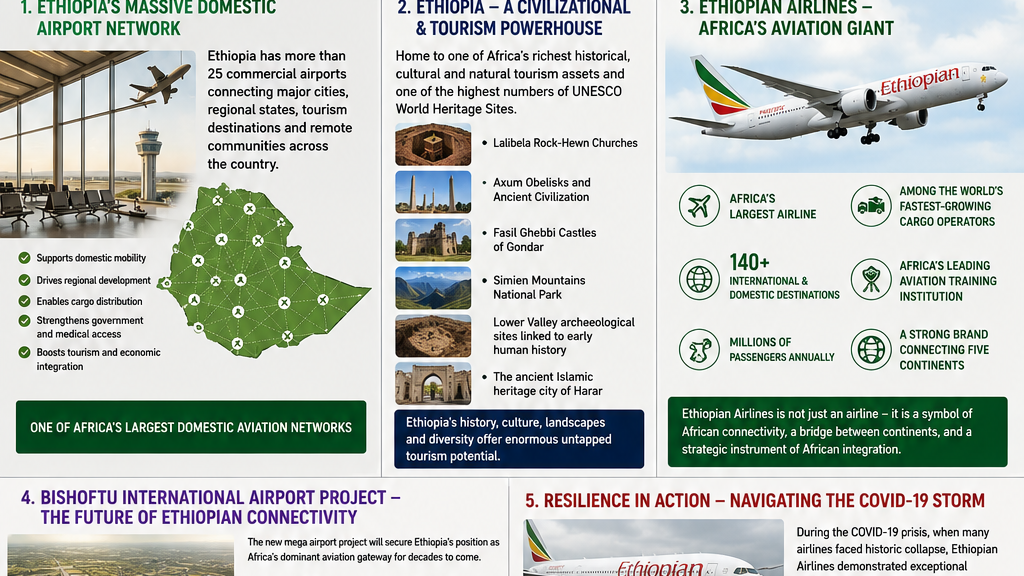
In terms of internal mobility, the territory utilizes a network of more than 25 commercial airports connecting various regional states, economic zones, and key cities. This domestic web underpins internal transport, cargo distribution, and regional market integration.
🚀 FUTURE HORIZONS: THE BISHOFTU MEGA-AIRPORT PROJECT
A key indicator of long-term aviation capacity planning in East African aviation is the proposed Bishoftu International Airport project.
Because current infrastructure at Bole is projecting eventual capacity saturation, and because Bole’s high altitude (2,334 meters above sea level) thins the air—forcing long-haul flights to carefully manage payload weights and fuel consumption—a new hub has been designated for development.
The Bishoftu project is structured around specific long-term operational targets:
🔹 Scale and Capacity: A multi-billion-dollar project designed to handle an initial 60 million passengers annually, with a long-term blueprint exceeding 100 million.
🔹 Aerodynamic Advantage: Located at a lower elevation than Bole, the site naturally improves aircraft engine performance, payload capacity, and fuel efficiency for long-haul routes.
🔹 Commercial Framework: Planned to feature an integrated “Airport City” to capture commercial and logistics growth.
🦠 THE COVID-19 CRUCIBLE: CORPORATE AGILITY IN A GLOBAL CRISIS
When the global aviation industry collapsed in 2020, forcing many legacy carriers into bankruptcy, Ethiopian Airlines maintained a cash-positive position without relying on external equity bailouts.
This resilience was driven strictly by independent corporate adaptability and a rapid pivot from passenger operations to cargo logistics:
• The “Preighter” Strategy: Utilizing its in-house Maintenance, Repair, and Overhaul (MRO) division, the carrier reconfigured 25 widebody passenger aircraft (including Airbus A350s) into temporary freighters by removing passenger seating to maximize cargo volume.
• Global Logistics Chain: This enabled the airline to rapidly scale up to handle massive, time-sensitive shipments of personal protective equipment (PPE), pharmaceuticals, and ultimately over 1 billion doses of vaccines globally.
💼 FIRSTHAND INSIDER PERSPECTIVE: STATION CRISIS MANAGEMENT
Having served Ethiopian Airlines for more than 15 years across both Africa and Europe, I witnessed this institutional resilience firsthand—not just from headquarters, but through direct leadership in the field.
During the height of the pandemic, I served as an ET Country Manager in Switzerland. When international borders closed, our station faced immediate operational jeopardy as corporate passenger revenue streams vanished overnight due to severe travel restrictions.
To safeguard the operation and prevent our station from complete closure, my team and I restructured our localized business model within a matter of weeks by aggressively executing a three-pronged market diversification strategy:
- The Swiss Post Transatlantic Pivot: Recognizing that traditional European legacy carriers had completely suspended or severely cut back their direct passenger routes from Switzerland to the United States, a massive bottleneck occurred for international mail. We stepped into this vacuum, capturing and establishing a high-volume cargo pipeline for Swiss Post to transport their critical international post and courier mail from Switzerland to the USA.
- Cargo Business Diversification and Revenue Recovery: Leveraging the carrier’s specialized cargo infrastructure and operational flexibility, we rapidly expanded multiple cargo segments during the pandemic period to help offset the significant decline in passenger revenue. This included the successful growth of general cargo, strategic logistics shipments, humanitarian supplies, e-commerce flows, and pharmaceutical cargo operations. Within a short period, our station became a reliable and important link in maintaining critical cargo connectivity during one of the most challenging periods for global aviation.
- Alternative Traffic Demographics: We shifted our ground sales completely away from business travel and successfully captured non-corporate demographics, VFR, specialized cargo sectors, repatriation flights, and diplomatic or humanitarian charter movements.
By acting with absolute speed, this comprehensive pivot completely replaced our lost corporate passenger revenue. We kept the station financially self-sustaining, saved our operations from being shut down, and demonstrated that agile operational leadership is what ultimately preserves connectivity during global shocks.
🛫 THE FLEET AND THE NETWORK
The airline currently operates a modern fleet of 147 aircraft with an average fleet age of under 7 years. This includes widebody models such as the Boeing 787 Dreamliner, Boeing 777s, and Airbus A350-900s, alongside a narrowbody fleet of Boeing 737 MAXs and De Havilland Q400s servicing shorter sectors.
To meet its long-term strategic targets, the carrier maintains active orders for more than 100 next-generation aircraft scheduled for delivery through 2032.
This backlog consists of:
• Additional Airbus A350-1000s and Boeing 787-9 Dreamliners to scale up high-demand intercontinental routes.
• A substantial order of Boeing 737 MAXs to tighten regional connectivity. • Boeing 777X widebodies intended for ultra-long-haul expansion.
• Continued evaluation of regional aircraft like the Airbus A220 to efficiently service developing secondary networks.
🏛 HISTORICAL, CULTURAL, AND GEOPOLITICAL FOOTPRINT
Aviation capacity in the Horn of Africa does not operate in isolation; it functions alongside the region’s geographical and cultural assets. As home to several prominent UNESCO World Heritage Sites—such as the rock-hewn churches of Lalibela, the obelisks of Axum, the castles of Gondar, and the historic city of Harar Jugol—the territory possesses significant stopover tourism potential that is directly fed by transit passenger volumes.
Furthermore, Addis Ababa’s geographic location serves as a natural continental bridge. Hosting the African Union (AU) Headquarters and the UN Economic Commission for Africa (UNECA), the city represents a major diplomatic capital, making the underlying aviation infrastructure an important element for continental diplomacy and humanitarian transport.
FINAL ASSESSMENT
The development of this aviation network offers a distinct case study in how long-term infrastructure investment and corporate flexibility can drive macroeconomic connectivity and trade under frameworks like the African Continental Free Trade Area (AfCFTA). The future of African aviation will depend heavily on building highly resilient, commercially self-sustaining ecosystems capable of adapting to shifting global realities.
🌍 Which country should be evaluated in Week 4 of The African Connectivity report? Share your suggestions and thoughts in the comments below.
#TheAfricanConnectivityProject #Ethiopia #EthiopianAirlines #AfricanAviation #Connectivity #Tourism #Africa #Cargo #AviationStrategy #AfCFTA #Travel #Investment #AviationLeadership #CrisisManagement #SwissPost #AirCargo #PharmaLogistics