

Nigeria: Africa’s Largest Aviation Market, Emerging ACMI Powerhouse, and the Missing Connections That Could Shape the Continent’s Future
Aviation & Charter Operations Professional | African Aviation Connectivity Strategist
After evaluating Ethiopia, Rwanda, South Africa, Kenya, and Angola in Weeks 1–5, this week’s analysis focuses on Nigeria—Africa’s largest population centre and one of the continent’s most significant aviation markets.
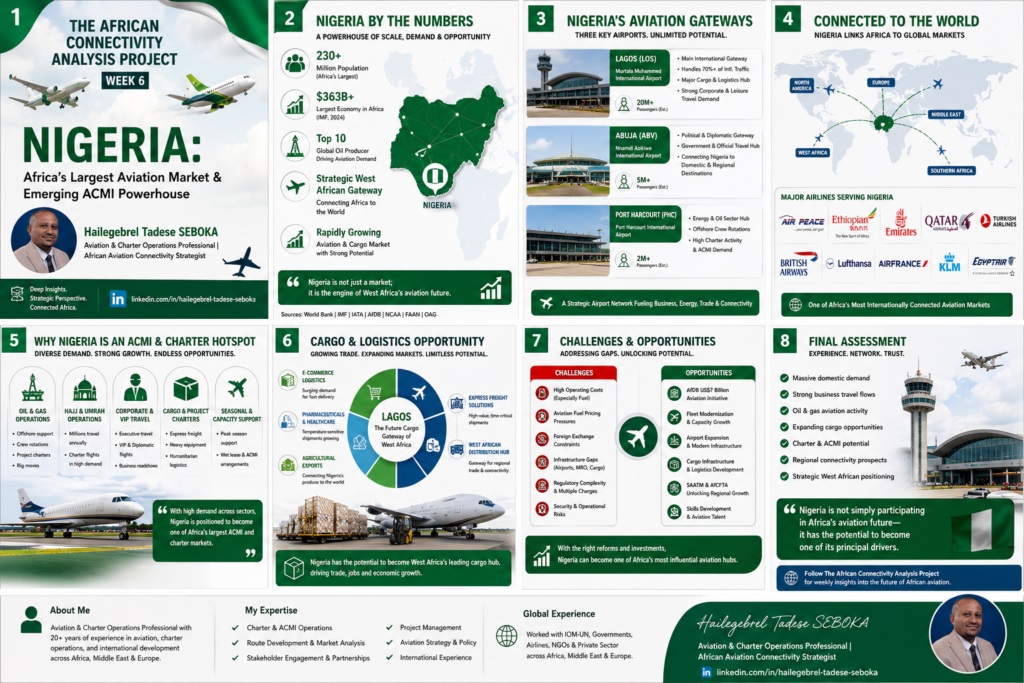
Nigeria is not only Africa’s most populous nation; it is also one of Africa’s most dynamic aviation markets. Driven by business travel, oil and gas activity, religious movements, cargo demand, regional trade, and a rapidly expanding middle class, Nigeria possesses all the ingredients necessary to become one of Africa’s leading aviation hubs.
With more than 230 million people, Africa’s largest economy by GDP, and a strategic location in West Africa, Nigeria’s aviation potential extends far beyond its domestic market.
Aviation Infrastructure
Nigeria’s aviation ecosystem is anchored by three strategic gateways:
Murtala Muhammed International Airport (Lagos)
Lagos remains Nigeria’s principal international gateway, characterised by strong corporate demand, extensive international connectivity, significant cargo activity, and growing transit potential.
Nnamdi Azikiwe International Airport (Abuja)
Abuja serves as Nigeria’s political and diplomatic gateway, supporting government travel, regional connectivity, and international engagement.
Port Harcourt International Airport
Port Harcourt plays a critical role in supporting Nigeria’s energy sector through executive mobility, offshore crew rotations, and charter activity.
International Connectivity
Nigeria maintains extensive links with Europe, the Middle East, North America, and several African regions. International carriers, including Emirates, Qatar Airways, Ethiopian Airlines, Turkish Airlines, British Airways, Lufthansa, Air France, KLM, EgyptAir, and RwandAir, continue to support these flows.
Air Peace has also emerged as a major contributor to Nigeria’s regional integration ambitions through its expanding domestic and international network.
ACMI and Charter Potential
Nigeria represents one of Africa’s strongest opportunities for ACMI and charter growth.
Key demand drivers include:
• Oil and gas operations
• Corporate mobility
• Government movements
• Religious charters
• Cargo charters
• Capacity support through wet leasing
In my view, Nigeria has the potential to become one of Africa’s largest ACMI and charter markets over the coming decade.
Cargo and Logistics Opportunities
Nigeria’s economic scale creates substantial opportunities in:
• Air cargo
• E-commerce logistics
• Pharmaceutical transport
• Agricultural exports
• Express freight
Lagos, in particular, has the potential to evolve into West Africa’s leading cargo gateway.
Challenges and Opportunities
Despite its enormous potential, Nigeria still faces challenges, including high operating costs, fuel pricing pressures, foreign exchange constraints, infrastructure gaps, and regulatory complexity.
At the same time, opportunities such as the African Development Bank’s US$7 billion Integrated Aviation Transformation Programme and the implementation of SAATM could significantly accelerate Nigeria’s aviation development.
Nigeria’s Missing Connections
Perhaps the most intriguing aspect of Nigeria’s aviation future lies not in the routes that already exist, but in those that do not.
Using a methodology based on GDS verification, airline schedules, airport publications, and industry analysis, several strategically important routes emerge as high-potential opportunities:
Abuja – Nairobi
A potential East–West Africa corridor supporting diplomacy, government travel, and business integration.
Lagos – Algiers
A strategic link connecting two of Africa’s largest hydrocarbon economies.
Lagos – Tunis
An underserved corridor with opportunities in medical tourism, education, and investment.
Port Harcourt – Luanda
A compelling oil and gas route with strong ACMI and charter potential.
Abuja – Dakar
A route capable of strengthening ECOWAS integration, diplomacy, and financial cooperation.
Importantly, routes are only classified as “missing” following rigorous verification. For example, Lagos–Kigali was initially considered a gap but was subsequently removed after GDS validation confirmed the existing RwandAir service.
Final Assessment
Nigeria’s aviation strength is not defined solely by its population size or economic output. Its true advantage lies in its ability to combine:
• Massive domestic demand
• Strong business travel flows
• Oil and gas aviation activity
• Expanding cargo opportunities
• Charter and ACMI potential
• Regional connectivity prospects
• Strategic West African positioning
As African aviation continues to evolve, Nigeria is likely to become one of the continent’s most influential markets for scheduled airlines, cargo operators, business aviation providers, charter companies, and ACMI operators.
However, Nigeria’s aviation future depends not only on strengthening existing routes and infrastructure. It will also depend on unlocking the connections Africa still lacks.
The future of African connectivity belongs to those capable of identifying not only where Africa flies today, but where it should fly tomorrow.