

The African Connectivity Analysis Report – Week 7
Zimbabwe: Southern Africa’s Tourism Jewel, Mining Connector, and the Missing Links That Could Unlock Its Aviation Future
By Hailegebrel Tadese SEBOKA
Aviation & Charter Operations Professional | African Aviation Connectivity Strategist
Following analyses of Ethiopia, Rwanda, South Africa, Kenya, Angola, and Nigeria in Weeks 1–6, this week’s study focuses on Zimbabwe—one of Southern Africa’s most strategically positioned yet underserved aviation markets.
Zimbabwe occupies a unique position at the crossroads of Southern and Central Africa. Despite possessing world-renowned tourism assets, a significant mining sector, and a highly educated population with strong regional business ties, the country’s air connectivity remains limited compared with its potential.
With a population of approximately 16 million people, a diversified economy anchored by mining, agriculture, tourism, and services, and globally recognised destinations such as Victoria Falls, Zimbabwe has all the ingredients necessary to become a more influential player in African aviation.
However, unlocking this potential requires more than strengthening existing routes. It requires connecting Zimbabwe to markets that remain underserved or entirely unserved.
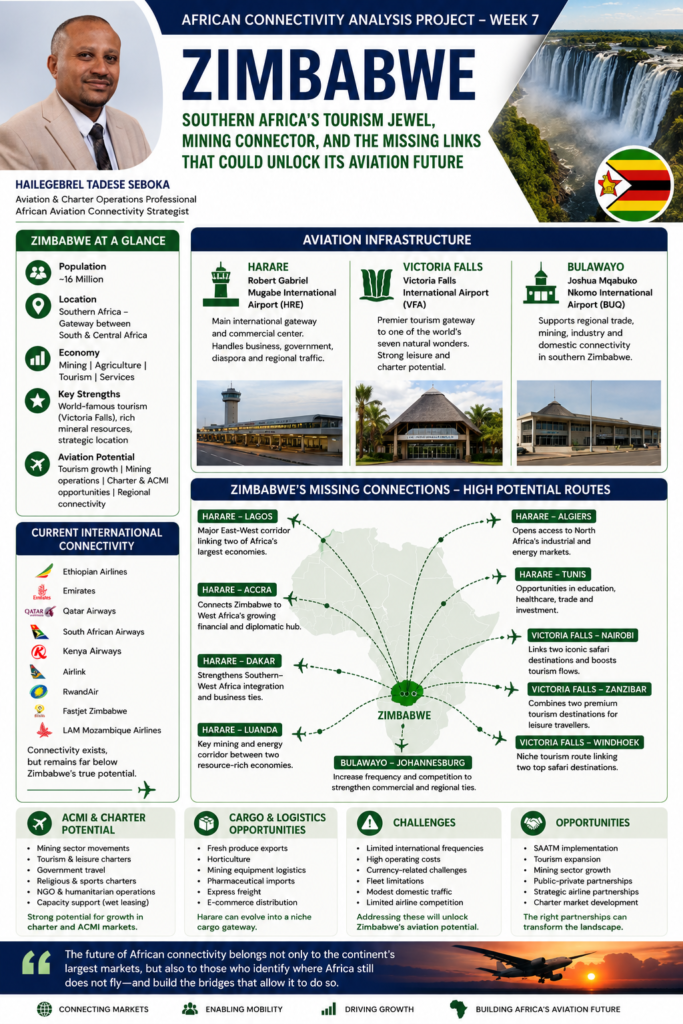
Zimbabwe at a Glance
- Population: Approximately 16 million
- Main Airports: Robert Gabriel Mugabe International Airport (Harare), Victoria Falls International Airport, Joshua Mqabuko Nkomo International Airport (Bulawayo)
- Key Economic Sectors: Mining, Agriculture, Tourism, Services
- Major Exports: Gold, Platinum, Tobacco, Lithium, Ferrochrome
- Current International Airlines: Ethiopian Airlines, Emirates, Qatar Airways, Kenya Airways, Airlink, RwandAir, South African Airways, Fastjet Zimbabwe, LAM Mozambique Airlines
- Strategic Position: Gateway between Southern, Eastern and Central Africa
Aviation Infrastructure: A Three-Gateway Matrix
Zimbabwe’s aviation network revolves around three strategic gateways, each serving a distinct commercial ecosystem:
Robert Gabriel Mugabe International Airport (Harare)
Zimbabwe’s principal international gateway and commercial centre. The airport acts as the primary hub for government travel, corporate business movements, diaspora traffic, and regional political connectivity.
Victoria Falls International Airport
The flagship tourism gateway. Tailored for pure international leisure travel, this airport serves as the entry point to one of Africa’s most iconic destinations, attracting high-yield global visitors.
Joshua Mqabuko Nkomo International Airport (Bulawayo)
A vital industrial gateway supporting regional cross-border trade, domestic mobility, heavy mining activities, and manufacturing development in southern Zimbabwe.
International Connectivity
Zimbabwe maintains links with selected African and international markets through carriers such as:
- Ethiopian Airlines
- Emirates
- Qatar Airways
- South African Airways
- Fastjet Zimbabwe
- Kenya Airways
- Airlink
- RwandAir
- LAM Mozambique Airlines
Despite the presence of these top-tier carriers, Zimbabwe remains significantly underserved compared with regional markets of similar strategic and geographic importance.
ACMI and Charter Potential
Because scheduled domestic capacity remains modest, Zimbabwe presents compelling opportunities for agile charter and ACMI (wet-leasing) development to bridge the gap.
Key demand drivers include:
- Mining Sector Movements: Shuttle flights for personnel and high-value cargo to remote sites.
- Tourism Charters: Seasonal, high-end private and group charters directly into Victoria Falls.
- Capacity Support: Wet-leasing opportunities for local operators during peak seasonal demand or fleet maintenance cycles.
- Additional Drivers: Government delegation travel, religious tourism, sports team movements, and regional NGO/humanitarian operations.
Cargo and Logistics Opportunities
Harare has the potential to evolve into a highly efficient niche cargo gateway serving both domestic demand and landlocked neighbouring markets.
Key untapped cargo segments include:
- Horticulture & Fresh Produce: High-value perishables destined for European and Middle Eastern markets.
- Mining Logistics: Inbound express freight for heavy machinery, spare parts, and specialized equipment.
- E-commerce & Pharma: Distribution of pharmaceutical imports and growing express regional e-commerce traffic.
Structural Challenges vs. Strategic Opportunities
The Constraints
- High Operating Costs: Elevated regional airport taxes and jet fuel costs that sit well above the global average.
- Financial Bottlenecks: Currency volatility and complex revenue repatriation challenges that deter aggressive foreign carrier investment.
- Operational Limits: Fleet capacity constraints among local operators and limited domestic market competition keeping ticket prices high.
The Catalysts
- SAATM Implementation: Capitalizing on the Single African Air Transport Market to eliminate protectionist barriers.
- Strategic Partnerships: Leveraging public-private partnerships and forming joint ventures with established regional carriers.
- Sector Growth: Direct alignment with expanding mining operations and luxury tourism infrastructure.
Africa’s Aviation Growth Context
According to IATA’s long-term demand forecasts, Africa is expected to be one of the fastest-growing aviation markets globally through 2050, with intra-African traffic projected to grow faster than any other regional market.
This growth will be driven by rapid population expansion, urbanization, rising incomes, and increasing demand for business and leisure travel.
Zimbabwe is well positioned to benefit from this growth provided it strengthens connectivity, attracts investment, expands market access, and leverages opportunities created by SAATM.
Zimbabwe’s Missing Connections: Where the Value Lies
The greatest opportunity in Zimbabwean aviation lies not in expanding the frequencies of routes currently operated, but in bridging the connectivity gaps that still exist across the continent.
Using a methodology based on airline schedules, airport publications, GDS verification, tourism flows, business demand, and regional trade analysis, several high-potential opportunities emerge.
The East-West & Regional Power Corridors
- Harare – Lagos: A vital East-West corridor linking Southern Africa with Africa’s largest economy.
- Harare – Luanda: A natural mining and energy corridor connecting two resource-rich economies.
- Harare – Accra: Connecting Zimbabwe with one of West Africa’s fastest-growing financial and diplomatic hubs.
- Harare – Dakar: An opportunity to strengthen Southern and West African political and commercial integration.
The Multi-Destination Tourism Circuits
- Victoria Falls – Zanzibar: Combining premium safari tourism with a world-class beach destination.
- Victoria Falls – Windhoek: Connecting Namibia’s desert tourism product with the Zambezi basin experience.
North African & Industrial Links
- Harare – Algiers: A corridor connecting Southern Africa with North Africa’s industrial and energy sectors.
- Harare – Tunis: Offering opportunities in medical tourism, education, and investment.
Enhanced Regional Mobility
- Bulawayo – Johannesburg: Increased frequencies and stronger low-cost carrier competition could stimulate substantial regional commerce and cross-border mobility.
Final Assessment
Zimbabwe’s aviation potential extends far beyond its current traffic volumes. Its true strength lies in its rare ability to combine world-class tourism, mining-driven corporate mobility, and a highly strategic geographic position in Southern Africa.
Zimbabwe’s future aviation success will not be determined solely by passenger volumes, but by its ability to position itself as a strategic connector between Southern, Eastern, Western, and Northern Africa.
As the continent moves toward greater integration under SAATM and AfCFTA, countries that proactively close connectivity gaps will capture disproportionate economic benefits.
Zimbabwe possesses the tourism assets, resource base, geographic location, and human capital required to become one of Africa’s most compelling aviation growth stories. The challenge now is translating potential into implementation.
The future of African connectivity belongs to those capable of identifying where Africa still does not fly—and building the bridges that allow it to do so.
#AfricanConnectivityAnalysis #Week7 #Zimbabwe #AfricanAviationIntelligence #SAATM #AfricanTourism #CharterAviation #ACMI #AirCargo #AfricanConnectivity