

Egypt: Africa’s Northern Gateway – Bridging Continents Through Aviation Connectivity
Executive Summary
Egypt occupies a unique position in African aviation. Located at the crossroads of Africa, Europe, the Middle East and Asia, the country serves as one of Africa’s most strategically positioned aviation hubs. With strong tourism demand, a diversified airport network, a growing national carrier, and extensive international connectivity, Egypt plays a critical role in linking Africa to global markets.
However, despite its strengths, significant opportunities remain to deepen intra-African connectivity and strengthen Egypt’s position as Africa’s premier northern gateway.
1. Why Egypt Matters in African Connectivity
Egypt is strategically positioned at the junction of three continents:
- Gateway between Africa and Europe.
- Natural bridge linking North Africa with the Middle East and Asia.
- Major tourism destination attracting millions of international visitors annually.
- One of Africa’s largest aviation markets and among the continent’s most connected countries.
Aviation contributes significantly to Egypt’s economy, supporting nearly 1.4 million jobs and accounting for over 5% of GDP when tourism and related activities are included.
Demographic Strength and Market Potential
Egypt is Africa’s third most populous country, with a population exceeding 115 million people, providing one of the continent’s largest domestic and outbound travel markets.
Several demographic characteristics make Egypt particularly attractive for aviation growth:
- Young Population: More than half of Egypt’s population is under the age of 30, creating a long-term pipeline of future air travelers with increasing mobility needs.
- Expanding Middle Class: Rising disposable incomes and urbanization continue to stimulate demand for both domestic and international air travel.
- Large Diaspora Community: Millions of Egyptians reside abroad, particularly in the Gulf States, Europe and North America, generating substantial Visiting Friends and Relatives (VFR) traffic throughout the year.
- Concentrated Urban Centers: Major metropolitan areas such as Cairo and Alexandria create strong passenger catchment areas that support high-frequency airline operations.
- Growing Business and Trade Links: Egypt’s expanding commercial ties with Africa, Europe, the Gulf and Asia continue to generate significant business travel demand.
Collectively, these demographic dynamics provide Egypt with a strong and resilient traffic base that supports sustained aviation growth and reinforces Cairo’s potential to evolve into Africa’s leading northern aviation hub.
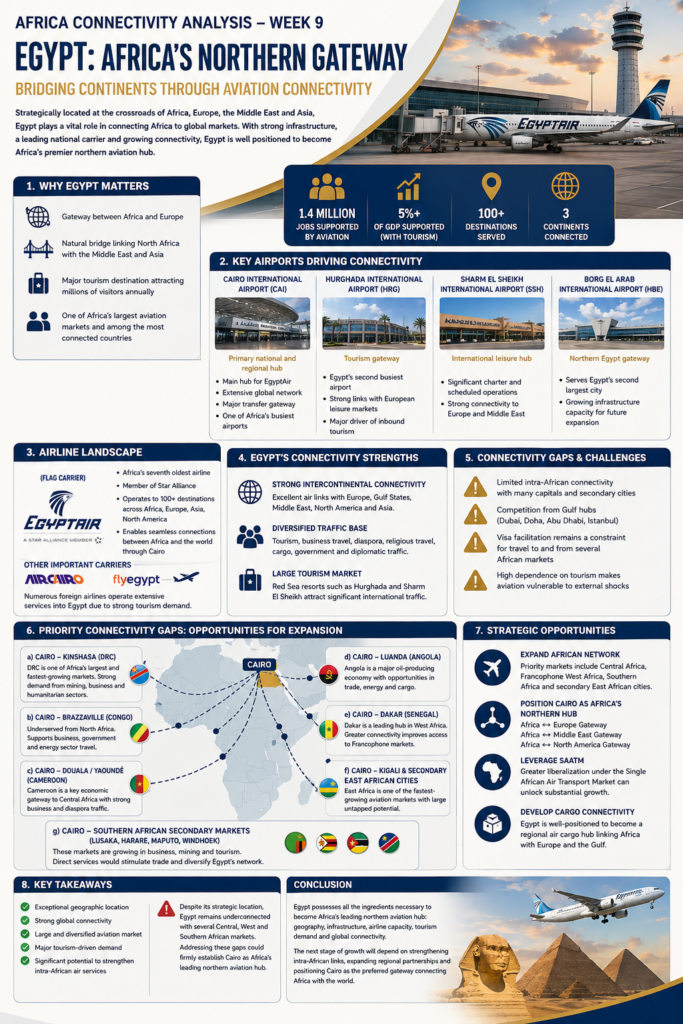
2. Key Airports Driving Connectivity
a) Cairo International Airport (CAI)
Role: Primary national and regional hub
Strengths:
- Main hub for EgyptAir.
- Extensive network across Africa, Europe, the Middle East, Asia and North America.
- Major transfer gateway between Sub-Saharan Africa and Europe and the Middle East.
- One of Africa’s busiest airports.
Challenges:
- Increasing congestion during peak periods.
- Strong competition from Gulf hubs such as Dubai, Doha and Abu Dhabi.
b) Hurghada International Airport (HRG)
Role: Tourism gateway
Strengths:
- Egypt’s second busiest airport.
- Strong direct connectivity with European leisure markets.
- Major driver of inbound tourism.
c) Sharm El Sheikh International Airport (SSH)
Role: International leisure hub
Strengths:
- Significant charter and scheduled operations.
- Strong connectivity to Europe and the Middle East.
d) Borg El Arab International Airport (HBE)
Role: Northern Egypt gateway
Strengths:
- Serves Egypt’s second-largest city and the Nile Delta region.
- Growing infrastructure capacity supports future expansion.
3. Airline Landscape
Flag Carrier: EgyptAir
Strengths:
- Africa’s seventh oldest airline.
- Member of the Star Alliance network.
- Operates an extensive network spanning Africa, Europe, Asia and North America.
- Serves more than 100 destinations through its network and subsidiaries.
Strategic Importance
EgyptAir enables seamless connections between African cities and major global markets through Cairo.
Other Important Carriers
- Air Cairo – expanding low-cost and leisure operations.
- FlyEgypt – regional and charter operations.
- Numerous foreign airlines operate extensive services into Egypt due to strong tourism demand.
4. Egypt’s Connectivity Strengths
Strong Intercontinental Connectivity
Egypt enjoys excellent air links with:
- Europe
- Gulf States
- Middle East
- North America
- Asia
This positions Cairo as a potential super-connector between Africa and the rest of the world.
Diversified Traffic Base
Unlike many African markets, Egypt benefits from multiple demand drivers:
- Tourism
- Business travel
- Diaspora traffic
- Religious travel
- Cargo
- Government and diplomatic traffic
Large Tourism Market
Tourism remains one of the principal drivers of Egyptian aviation growth. Red Sea resorts such as Hurghada and Sharm El Sheikh attract significant international traffic.
5. Connectivity Gaps and Challenges
Limited Intra-African Connectivity
Despite strong global connectivity, direct air services between Egypt and many African capitals remain limited.
Examples include:
- Few direct links to Central Africa.
- Limited frequencies to parts of West Africa.
- Weak connectivity to secondary African cities.
Competition from Gulf Hubs
Airports in Dubai, Doha, Abu Dhabi and Istanbul continue to capture significant Africa-Europe and Africa-Asia transfer traffic.
Visa Facilitation
Visa requirements continue to constrain travel demand between Egypt and several African markets.
High Dependence on Tourism
External shocks affecting tourism can significantly impact aviation performance.
6. Priority Connectivity Gaps: Targeted Opportunities for Expansion
| Route Pair | Current Status | Strategic Importance |
| Cairo – Kinshasa (DRC) | Underserved; limited frequencies | High-growth market with strong demand from mining, corporate, diplomatic and humanitarian sectors. Improved connectivity would strengthen North-Central Africa integration. |
| Cairo – Brazzaville (Congo) | Heavy reliance on indirect routing | Supports expanding energy, oil & gas, and government sector travel while strengthening Egypt’s footprint in Central Africa. |
| Cairo – Douala / Yaoundé (Cameroon) | Frequencies below market demand | Cameroon is a major economic gateway to Central Africa with strong business, diplomatic and diaspora traffic potential. |
| Cairo – Luanda (Angola) | Limited direct connectivity | Angola’s oil-driven economy presents significant opportunities in corporate travel, trade and cargo. |
| Cairo – Dakar (Senegal) | Low frequencies and indirect options | Dakar is a leading diplomatic and commercial hub in West Africa and a strategic gateway to Francophone markets. |
| Cairo – Kigali and Secondary East African Cities | Connectivity concentrated on primary capitals | East Africa is Africa’s fastest-growing aviation region, with significant untapped demand in secondary markets. |
| Cairo – Southern African Secondary Markets (Lusaka, Harare, Maputo and Windhoek) | Dependent on lengthy one-stop connections | Direct services would stimulate trade, business and tourism while diversifying Cairo’s network. |
7. Strategic Opportunities Moving Forward
Aggressively Expand the Sub-Saharan Network
Prioritize commercial operations into Central Africa, Francophone West Africa and Southern African growth markets to build a balanced and resilient hub network.
Leverage Alliance Partnerships
Fully exploit Star Alliance partnerships to offer seamless multi-airline itineraries and position Cairo as the preferred gateway for traffic flows between:
- Africa ↔ Europe
- Africa ↔ Middle East
- Africa ↔ North America
Champion SAATM Liberalization
Actively leverage the Single African Air Transport Market (SAATM) framework to reduce bilateral constraints, open additional traffic rights and lower operational barriers.
Accelerate Air Cargo Integration
Capitalize on Egypt’s strategic location and infrastructure to develop a world-class cargo hub linking African exports directly with Europe and the Middle East.
8. Key Takeaways
✅ Exceptional geographic location at the crossroads of three continents.
✅ Strong global and intercontinental connectivity.
✅ Large and diversified aviation market supported by tourism, business and diaspora demand.
✅ EgyptAir and Star Alliance membership provide significant network advantages.
✅ Considerable potential exists to strengthen intra-African connectivity.
⚠️ Despite its strategic position, Egypt remains under-connected to several high-growth markets in Central, West and Southern Africa.
Conclusion
Egypt possesses all the structural ingredients necessary to solidify its status as Africa’s premier northern aviation gateway: an exceptional geographic position, robust airport infrastructure, a globally connected flag carrier, strong tourism demand and a large domestic market.
The next era of growth will depend on transforming Cairo from a predominantly tourism-driven market into a deeply integrated continental transit hub. By aggressively addressing intra-African connectivity gaps, leveraging international alliance partnerships and embracing aviation liberalization initiatives, Egypt can firmly establish itself as Africa’s preferred northern super-connector linking the continent with the global economy.