

Senegal: Dakar’s Rise as West Africa’s Premier Aviation Gateway and the Strategic Connectivity Opportunities That Could Redefine the Atlantic Corridor
Executive Summary
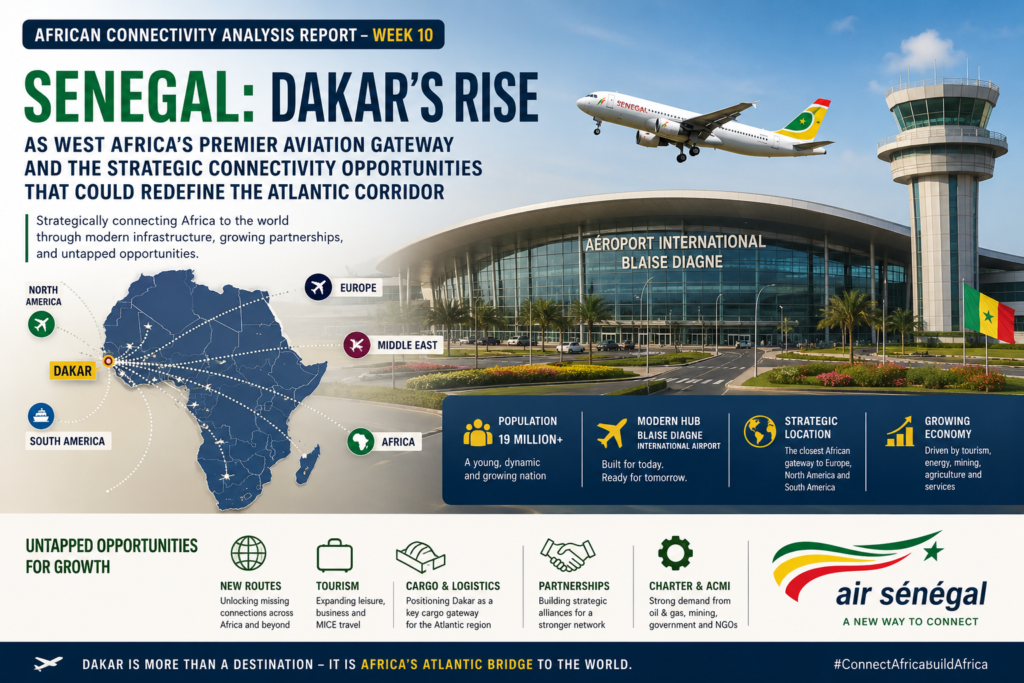
Senegal has quietly emerged as one of Africa’s most promising aviation success stories. Anchored by the world-class Blaise Diagne International Airport (DSS), a stable political environment, an expanding tourism industry, a diversified economy, and a strategic geographic location at Africa’s westernmost point, the country is increasingly positioning itself as the principal gateway between West Africa, Europe, North America, and the Atlantic region.
Unlike many African aviation markets that continue to face infrastructure constraints, Senegal has invested heavily in modern airport facilities capable of supporting long-term passenger and cargo growth. Combined with the growing influence of Air Sénégal, expanding offshore oil and gas activities, and increasing international investment, Dakar is rapidly evolving into one of Africa’s most strategically positioned aviation hubs.
Nevertheless, despite these strengths, several African, North American, Middle Eastern, and South American markets remain underserved or entirely unserved. Significant opportunities exist to strengthen Dakar’s role as both a passenger connecting hub and a cargo gateway serving the Atlantic corridor.
This Week 10 edition of the African Connectivity Analysis examines Senegal’s aviation infrastructure, international connectivity, cargo potential, charter and ACMI opportunities, and the strategic route gaps that could define the country’s future within Africa’s evolving aviation ecosystem.
Previous Editions in the African Connectivity Analysis Series
Before exploring Week 10: Senegal, I invite readers to revisit the previous editions of this series, where we examined the aviation ecosystems, connectivity strengths, infrastructure development, and strategic opportunities across Africa. Together, these reports provide a growing continent-wide perspective on the future of African aviation.
Published Reports
Week 1: Rwanda – Building East Africa’s Aviation Hub
Week 2: South Africa – Africa’s Largest Aviation Market
Week 3: Ethiopia – Africa’s Aviation Powerhouse
Week 4: Kenya – East Africa’s Gateway to the World
Week 5: Angola – Unlocking Central and Southern Africa’s Aviation Potential
Week 6: Nigeria – Africa’s Largest Aviation Market by Population
Week 7: Zimbabwe – Strategic Opportunities at the Heart of Southern Africa
Week 8: Ghana – West Africa’s Emerging Aviation Gateway
Week 9: Egypt – Africa’s Northern Aviation Gateway
Each report analyzes:
- Aviation infrastructure
- International airline connectivity
- Cargo and logistics opportunities
- Charter and ACMI market potential
- Tourism and economic drivers
- Missing international air links
- Strategic recommendations to improve African connectivity
If you missed any of the previous editions, I encourage you to go back and read them. Together, they provide a comprehensive picture of how improved aviation connectivity can accelerate economic integration, trade, tourism, investment, and sustainable development across Africa.
Introduction
Following our analyses of Rwanda, South Africa, Ethiopia, Kenya, Angola, Nigeria, Zimbabwe, Ghana, and Egypt, this week’s study focuses on Senegal, one of West Africa’s fastest-growing aviation markets.
Situated on Africa’s Atlantic coast, Senegal occupies one of the continent’s most strategic geographic positions. Dakar serves as the closest major African gateway to Europe and North America while functioning as a natural bridge between West Africa, the Sahel, and transatlantic markets.
The country’s political stability, expanding tourism industry, offshore energy discoveries, pro-business reforms, and growing international investment continue to strengthen demand for both passenger and cargo aviation.
With a population approaching 19 million and one of West Africa’s fastest-growing economies, Senegal is steadily positioning itself as an important regional business, diplomatic, logistics, and tourism center.
The inauguration of Blaise Diagne International Airport (DSS) represented a major turning point, providing modern infrastructure capable of supporting Dakar’s ambition of becoming one of Africa’s leading aviation hubs.
Senegal at a Glance
- Population: Approximately 19 million
- Capital: Dakar
- Main International Airport: Blaise Diagne International Airport (DSS)
- Secondary Airports: Cap Skirring, Saint-Louis, Ziguinchor
- National Airline: Air Sénégal
- Key Economic Sectors:
- Tourism
- Fisheries
- Agriculture
- Phosphates
- Gold Mining
- Oil & Gas
- Financial Services
- Logistics
- Strategic Position:
- Westernmost aviation gateway in continental Africa
- Natural bridge between Africa, Europe, North America and South America
Aviation Infrastructure: Senegal’s Modern Gateway
Blaise Diagne International Airport (DSS)
Opened in 2017, Blaise Diagne International Airport is among Africa’s newest and most modern airports.
Its strengths include:
- Modern passenger terminals
- Long runway capable of accommodating wide-body aircraft
- Significant cargo handling capacity
- Room for future expansion
- Direct motorway and rail connectivity to Dakar
- Infrastructure designed to support hub operations
Unlike many congested African airports, DSS was designed with long-term growth in mind.
International Connectivity
Dakar enjoys excellent connectivity with Europe and West Africa.
Major airlines serving Senegal include:
- Air Sénégal
- Air France
- Brussels Airlines
- Iberia
- TAP Air Portugal
- Turkish Airlines
- Ethiopian Airlines
- Emirates
- Royal Air Maroc
- Mauritania Airlines
- Air Côte d’Ivoire
- ASKY Airlines
- Transavia
These airlines connect Dakar with major destinations across:
- Europe
- West Africa
- North Africa
- East Africa
- The Middle East
However, opportunities remain to strengthen connectivity with Southern Africa, Central Africa, North America, and Latin America.
Air Sénégal: National Carrier with Regional Ambitions
Air Sénégal has become one of Africa’s youngest and most ambitious airlines.
Its fleet includes:
- Airbus A330neo
- Airbus A220
- ATR 72-600
The airline’s strategy focuses on:
- Expanding African connectivity
- Strengthening European services
- Increasing long-haul operations
- Supporting tourism
- Positioning Dakar as a regional connecting hub
ACMI and Charter Potential
Senegal offers strong opportunities for ACMI providers and charter operators.
Key Demand Drivers
Offshore Oil & Gas
Growing offshore energy projects require:
- Crew rotations
- Executive charters
- Technical support flights
- Cargo logistics
Mining
Gold and phosphate industries generate demand for:
- Personnel transportation
- Equipment movement
Government & Diplomatic Travel
Dakar hosts numerous:
- African Union meetings
- ECOWAS activities
- International conferences
- Diplomatic missions
Tourism
Growing leisure demand supports:
- Seasonal charters
- Cruise passenger transfers
- VIP movements
Sports
Football tournaments and international events continue generating charter demand.
Cargo and Logistics Opportunities
Dakar possesses significant cargo growth potential.
Key opportunities include:
- Seafood exports
- Fresh fruits and vegetables
- Pharmaceuticals
- E-commerce logistics
- Oil & gas equipment
- Humanitarian cargo
- Express freight
Its Atlantic location provides excellent opportunities to become a regional cargo distribution center.
Structural Challenges vs Strategic Opportunities
Key Constraints
- Strong competition from Casablanca, Lagos, Abidjan, Lomé and Accra
- Limited long-haul African connectivity
- Relatively small domestic market
- Competition from Gulf carriers
Growth Catalysts
- SAATM implementation
- AfCFTA
- Air Sénégal expansion
- Offshore oil and gas development
- Tourism growth
- Continued infrastructure investment
- Increasing foreign direct investment
Africa’s Aviation Growth Context
Africa is expected to remain one of the fastest-growing aviation markets through 2050.
Driven by:
- Population growth
- Urbanization
- Rising middle-class incomes
- AfCFTA
- SAATM
Passenger and cargo demand will continue expanding rapidly.
Senegal is particularly well positioned to benefit because of its strategic Atlantic location, political stability, modern infrastructure, and growing economy.
Senegal’s Missing Connections: Where the Value Lies
Based on airline schedules, airport publications, tourism flows, trade volumes, cargo demand, business travel patterns, and GDS analysis, several high-potential routes emerge.
Southern Africa
• Dakar – Johannesburg
Africa’s two major economic regions remain poorly connected. A direct service would strengthen business, tourism, cargo, and investment links between West and Southern Africa.
• Dakar – Windhoek
Would improve access to Namibia’s growing mining, tourism, and logistics sectors while supporting greater regional integration.
• Dakar – Gaborone
Botswana’s stable economy and diamond industry present opportunities for business travel, government cooperation, and investment.
East Africa
• Dakar – Kigali
Rwanda’s growing role as an innovation, conference, and investment hub makes this an attractive route for business and government travel.
• Dakar – Dar es Salaam
Would strengthen trade links with East Africa while supporting tourism, maritime industries, and cargo connectivity.
Central Africa
• Dakar – Douala
Would connect two important commercial centers, supporting trade, manufacturing, banking, and energy sector movements.
• Dakar – Libreville
Growing oil, gas, and mining industries create demand for business travel and specialized charter operations.
• Dakar – Kinshasa
The Democratic Republic of the Congo’s large population and expanding economy represent one of Africa’s most significant underserved aviation markets.
North Africa
• Dakar – Tripoli
As Libya continues to rebuild its economy and aviation sector, future direct connectivity could support business, reconstruction, and regional trade.
Indian Ocean
• Dakar – Mauritius
Would create a strategic link between West Africa and one of Africa’s leading financial, tourism, and investment destinations.
Strategic Intercontinental Opportunities
While strengthening intra-African connectivity should remain Senegal’s highest priority, Dakar’s unique Atlantic location also creates opportunities to expand strategic intercontinental links that support trade, tourism, investment, and cargo flows.
Middle East
- Dakar – Abu Dhabi
Would diversify Gulf connectivity while strengthening investment, tourism, and cargo links. - Additional Dakar – Doha frequencies
Would improve onward connectivity to Asia, Australia, and the Middle East through one of the world’s leading hub airports.
North America
- Dakar – Washington, D.C.
Would strengthen diplomatic, governmental, and development cooperation while serving the West African diaspora. - Dakar – Montreal
Would reinforce Francophone ties, education, tourism, and growing commercial relations. - Dakar – Chicago
Would provide access to one of North America’s largest commercial and cargo markets.
Latin America
• Dakar – Recife
Dakar and Recife are among the closest major cities across the South Atlantic. A direct route could stimulate tourism, trade, cultural exchange, and future Africa–Brazil connectivity.
• Dakar – São Paulo
Would connect West Africa with South America’s largest economic center, supporting trade, investment, cargo, and business travel between the two regions.
Strategic Observation
Given Dakar’s unique location as the westernmost major gateway on the African continent, South America represents one of the most significant untapped aviation opportunities. Direct services to Brazil would not only shorten travel times but also strengthen economic, cultural, tourism, and cargo links across the South Atlantic, positioning Dakar as a natural bridge between Africa and Latin America.
This strategic advantage is one of Senegal’s strongest yet underutilized assets and could play a pivotal role in the next phase of African aviation connectivity.
Final Assessment
Senegal is no longer simply another West African destination—it is steadily emerging as one of Africa’s most strategically positioned aviation gateways.
The combination of Blaise Diagne International Airport, a stable political environment, a growing national airline, expanding offshore energy developments, and a thriving tourism sector provides a strong foundation for long-term aviation growth.
Its greatest opportunity lies in leveraging its geographic position to become the preferred Atlantic hub connecting West Africa with Europe, North America, South America, and underserved African markets.
As Africa advances toward greater economic integration through AfCFTA and SAATM, countries capable of bridging connectivity gaps will capture a disproportionate share of future aviation growth.
Senegal possesses the infrastructure, strategic location, institutional stability, and economic momentum required to become one of Africa’s most influential aviation gateways.
The future of African connectivity belongs to those who connect regions—not just cities. Dakar is uniquely positioned to become the bridge between Africa and the Atlantic world.