
Morocco: Africa’s Gateway to Europe, Aerospace Leader, and the Strategic Hub Connecting Two Continents
Executive Summary
Morocco has emerged as one of Africa’s most sophisticated aviation markets, combining world-class airport infrastructure, a strong national carrier, a thriving tourism industry, and a rapidly expanding aerospace manufacturing sector. Strategically located at the crossroads of Europe, Africa, the Atlantic Ocean, and the Mediterranean Sea, Morocco has successfully positioned itself as one of the continent’s leading international aviation gateways.
Unlike many African markets that rely primarily on domestic demand, Morocco has built an aviation ecosystem centered on international connectivity. Casablanca has evolved into a major hub linking Europe, North America, the Middle East, and an expanding network across Africa through Royal Air Maroc.
Despite these achievements, significant opportunities remain to strengthen Morocco’s connectivity with emerging African markets, expand cargo operations, support the objectives of the Single African Air Transport Market (SAATM), and reinforce its position as Africa’s premier intercontinental gateway.
This Week 11 edition of the African Connectivity Analysis series examines Morocco’s aviation infrastructure, international connectivity, cargo opportunities, aerospace industry, charter and ACMI potential, and the strategic route opportunities that could define its aviation future.
Introduction
Following analyses of Ethiopia, Rwanda, South Africa, Kenya, Angola, Nigeria, Zimbabwe, Ghana, Egypt, and Senegal in Weeks 1–10, this week’s study focuses on Morocco—one of Africa’s most internationally connected aviation markets.
Morocco occupies one of the world’s most strategic geographic positions. Located only 14 kilometers from Europe across the Strait of Gibraltar, the country serves as a natural bridge between Africa and Europe while maintaining strong commercial and diplomatic links with North America, the Middle East, and the rest of Africa.
With a population of approximately 38 million people, a diversified economy, and one of Africa’s most advanced aerospace industries, Morocco has successfully leveraged aviation as a driver of economic growth, tourism, international trade, and investment.
At the center of this success is Royal Air Maroc, whose hub-and-spoke strategy at Casablanca Mohammed V International Airport has significantly enhanced Morocco’s role in connecting African passengers with Europe and North America.
As Africa advances toward greater economic integration through AfCFTA and SAATM, Morocco is well positioned to become one of the continent’s most influential aviation hubs.
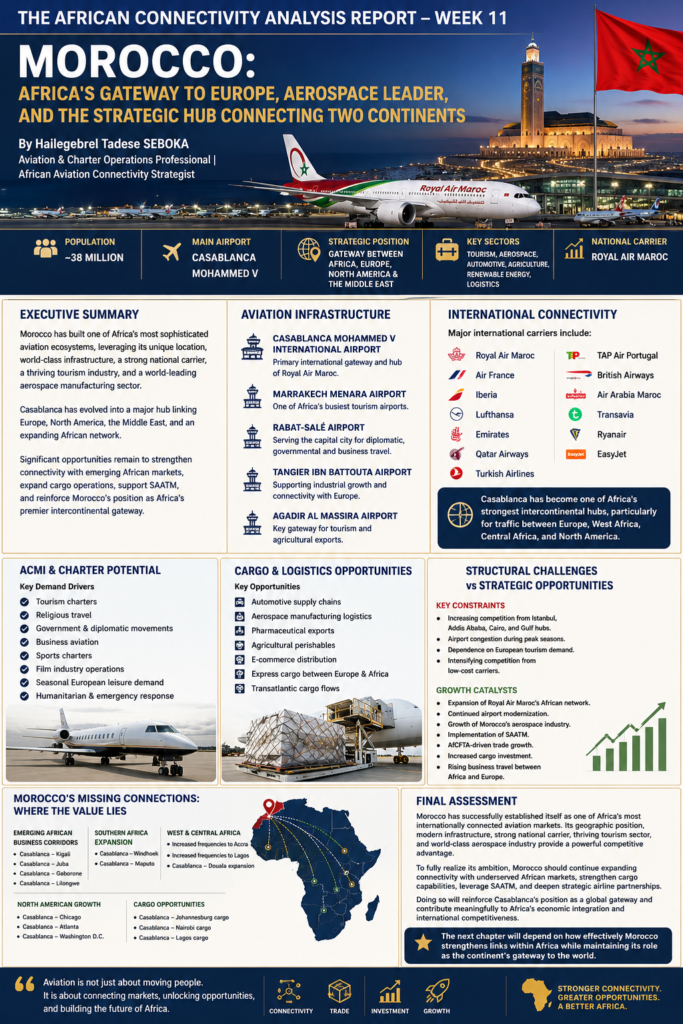
Morocco at a Glance
- Population: Approximately 38 million
- Main Airports:
- Casablanca Mohammed V International Airport
- Marrakech Menara Airport
- Rabat-Salé Airport
- Tangier Ibn Battouta Airport
- Agadir Al Massira Airport
- Key Economic Sectors:
- Tourism
- Automotive Manufacturing
- Aerospace Manufacturing
- Agriculture
- Renewable Energy
- Logistics
- Major Exports:
- Automobiles
- Aerospace Components
- Phosphates
- Agricultural Products
- Textiles
- National Carrier:
- Royal Air Maroc
- Strategic Position:
- Gateway between Africa, Europe, North America, and the Middle East
Aviation Infrastructure: A Multi-Hub Network
Casablanca Mohammed V International Airport
Morocco’s primary international gateway and the home hub of Royal Air Maroc. Casablanca serves as the country’s principal connecting airport, facilitating passenger and cargo flows between Africa and major international markets.
Marrakech Menara Airport
One of Africa’s busiest tourism airports, supporting millions of leisure travelers each year and strengthening Morocco’s position as one of the world’s leading tourist destinations.
Rabat-Salé Airport
Serving the capital city, the airport supports diplomatic, governmental, and business travel.
Tangier Ibn Battouta Airport
Supporting Morocco’s rapidly growing industrial and logistics sectors while facilitating connectivity with Europe.
Agadir Al Massira Airport
A key gateway for tourism and agricultural exports from southern Morocco.
International Connectivity
Morocco enjoys one of Africa’s most extensive international airline networks.
Major international carriers include:
- Royal Air Maroc
- Air France
- Iberia
- Lufthansa
- Emirates
- Qatar Airways
- Turkish Airlines
- TAP Air Portugal
- British Airways
- Air Arabia Maroc
- Transavia
- Ryanair
- EasyJet
Casablanca has become one of Africa’s strongest intercontinental hubs, particularly for traffic between Europe, West Africa, Central Africa, and North America.
ACMI and Charter Potential
Morocco offers significant opportunities for charter and ACMI operators.
Key Demand Drivers
- Tourism charters
- Religious travel
- Government and diplomatic movements
- Business aviation
- Sports charters
- Film industry operations
- Seasonal European leisure demand
- Humanitarian and emergency response operations
Cargo and Logistics Opportunities
Morocco has become one of Africa’s fastest-growing logistics centers.
Key opportunities include:
- Automotive supply chains
- Aerospace manufacturing logistics
- Pharmaceutical exports
- Agricultural perishables
- E-commerce distribution
- Express cargo between Europe and Africa
- Transatlantic cargo flows
Structural Challenges vs Strategic Opportunities
Key Constraints
- Increasing competition from Istanbul, Addis Ababa, Cairo, and Gulf hubs.
- Airport congestion during peak tourism seasons.
- Dependence on European tourism demand.
- Intensifying competition from low-cost carriers.
Growth Catalysts
- Expansion of Royal Air Maroc’s African network.
- Continued airport modernization.
- Growth of Morocco’s aerospace manufacturing industry.
- Implementation of SAATM.
- AfCFTA-driven trade growth.
- Increased cargo investment.
- Rising business travel between Africa and Europe.
Africa’s Aviation Growth Context
Africa is projected to become one of the fastest-growing aviation regions over the coming decades. Morocco’s geographic position, diversified economy, strong tourism sector, and modern aviation infrastructure provide a unique competitive advantage.
As trade between Africa and Europe continues to expand, Morocco is exceptionally well positioned to strengthen its role as one of the continent’s primary aviation gateways.
Morocco’s Missing Connections: Where the Next Growth Opportunities Lie
Despite Morocco’s extensive international network, several high-potential markets across Africa and North America remain underserved or unserved. As AfCFTA and SAATM accelerate regional integration, expanding into these markets would diversify Royal Air Maroc’s network, strengthen Casablanca’s hub strategy, stimulate trade and tourism, and reinforce Morocco’s role as Africa’s premier gateway to Europe and beyond.
Strategic Network Development Recommendations
To strengthen Casablanca’s position as Africa’s leading intercontinental hub, Royal Air Maroc should prioritize a phased expansion strategy focusing on high-growth, underserved markets that align with Morocco’s economic, diplomatic, tourism, and cargo objectives. The following recommendations consider market demand, route distance, aircraft economics, operational efficiency, and long-term network sustainability.
| Proposed Route | Strategic Opportunity | Approx. Distance | Recommended Aircraft | Suggested Frequency | Why This Route Matters |
| Casablanca – Kigali | Finance, AfCFTA, Tourism, Technology | ~5,600 km | Airbus A321XLR | 4 weekly | Connects Morocco with one of Africa’s fastest-growing business and innovation hubs while strengthening East Africa–Europe connectivity. |
| Casablanca – Juba | UN, NGOs, Energy, Government | ~4,900 km | Embraer E195-E2 | 3 weekly | Supports humanitarian operations, diplomatic travel, and South Sudan’s developing economy with right-sized capacity. |
| Casablanca – Gaborone | Mining, Finance, Diplomacy | ~7,600 km | Boeing 787-8 | 2–3 weekly | Strengthens Morocco’s presence in Southern Africa and improves access to Botswana’s stable business environment. |
| Casablanca – Lilongwe | Agriculture, Development, Government | ~6,900 km | Airbus A321XLR | 2 weekly | Creates new links with Malawi while supporting development agencies, agricultural trade, and investment. |
| Casablanca – Windhoek | Tourism, Mining, Renewable Energy | ~7,100 km | Boeing 787-8 | 3 weekly | Enhances connectivity with Namibia’s growing tourism and mining sectors while improving Europe–Southern Africa links. |
| Casablanca – Maputo | LNG, Mining, Trade, Investment | ~8,300 km | Boeing 787-9 | 3 weekly | Supports Mozambique’s expanding energy sector and growing commercial relations with North Africa and Europe. |
| Casablanca – Accra | Finance, Trade, Regional Business | ≈ 3,180 km | Boeing 737 MAX 8 | Daily | Higher frequencies improve connectivity for business travelers and reinforce Casablanca’s West African hub strategy. |
| Casablanca – Lagos | Africa’s Largest Economy | ≈ 3,860 km | Boeing 787-8 / B737 MAX 8 | Double Daily | Strengthens access to Nigeria’s large corporate market while increasing passenger and cargo opportunities. |
| Casablanca – Douala | Manufacturing, Trade, CEMAC Gateway | ≈ 3,890 km | Boeing 737 MAX 8 | Daily | Supports Central African trade and positions Casablanca as a preferred gateway to Europe. |
| Casablanca – Chicago | Business, Cargo, African Diaspora | ~6,900 km | Boeing 787-9 | 4 weekly | Expands Royal Air Maroc’s North American network and captures business, tourism, and cargo demand. |
| Casablanca – Atlanta | Corporate Travel, Logistics | ~6,800 km | Boeing 787-9 | 3 weekly | Connects Africa to one of the world’s largest aviation and business hubs while strengthening U.S.–Africa connectivity. |
| Casablanca – Washington, D.C. | Diplomacy, Government, International Organizations | ~6,100 km | Boeing 787-8 | 4 weekly | Supports diplomatic, governmental, and institutional travel while strengthening Morocco’s political and economic ties with North America. |
Strategic Cargo Network Recommendations
Morocco’s ambition to become Africa’s leading logistics gateway should also include expanding dedicated cargo services to support high-value trade flows.
| Cargo Route | Primary Commodities | Recommended Aircraft | Suggested Frequency | Strategic Value |
| Casablanca – Johannesburg | Automotive Parts, Aerospace Components, Pharmaceuticals | Boeing 777F | 3 weekly | Supports North–South African industrial supply chains. |
| Casablanca – Nairobi | Flowers, Fresh Produce, Pharmaceuticals, E-commerce | Boeing 767-300F | 3 weekly | Strengthens East Africa–Europe perishables and express freight connectivity. |
| Casablanca – Lagos | General Cargo, Industrial Equipment, E-commerce | Boeing 767-300F | 4 weekly | Supports one of Africa’s largest cargo markets and growing consumer demand. |
| Casablanca – Addis Ababa (Future Opportunity) | Aerospace Components, High-Value Manufacturing, Pharmaceuticals | Boeing 767-300F | 2 weekly | Creates a strategic cargo bridge between two of Africa’s leading aviation and manufacturing hubs. |
Strategic Observation
These proposed routes are not simply about adding new destinations. They represent high-value economic corridors that align with the objectives of AfCFTA and SAATM by improving trade, investment, tourism, cargo logistics, and business mobility across the continent. By selectively expanding into underserved markets while increasing frequencies on high-demand routes, Royal Air Maroc can further strengthen Casablanca’s position as one of Africa’s leading intercontinental hubs, connecting African economies more efficiently with Europe, North America, and the rest of the world.
Final Assessment
Morocco has successfully established itself as one of Africa’s most internationally connected aviation markets. Through strategic investment in airports, aerospace manufacturing, tourism, and Royal Air Maroc, the country has built an aviation ecosystem that extends far beyond passenger transport.
Its greatest competitive advantage lies in its geographic position, enabling it to serve as a natural bridge between Africa, Europe, and North America. Combined with modern infrastructure, a diversified economy, and a growing aerospace sector, Morocco possesses many of the attributes required to become Africa’s leading intercontinental aviation hub.
To fully realize this ambition, Morocco should continue expanding connectivity with underserved African markets, strengthen cargo capabilities, leverage SAATM, and deepen strategic airline partnerships. Doing so will not only reinforce Casablanca’s position as a global gateway but also contribute meaningfully to Africa’s economic integration and international competitiveness.
As Africa enters a new era of aviation growth, Morocco demonstrates that long-term success is built on strategic vision, connectivity, infrastructure, and international partnerships. The next chapter will depend on how effectively it strengthens links within Africa while maintaining its role as the continent’s gateway to the world.