

Côte d’Ivoire: Abidjan’s Emergence as West Africa’s Next Aviation Hub and Strategic Connectivity Opportunities
By Hailegebrel Tadese SEBOKA
Aviation & Charter Operations Professional | African Aviation Connectivity Strategist
Executive Summary
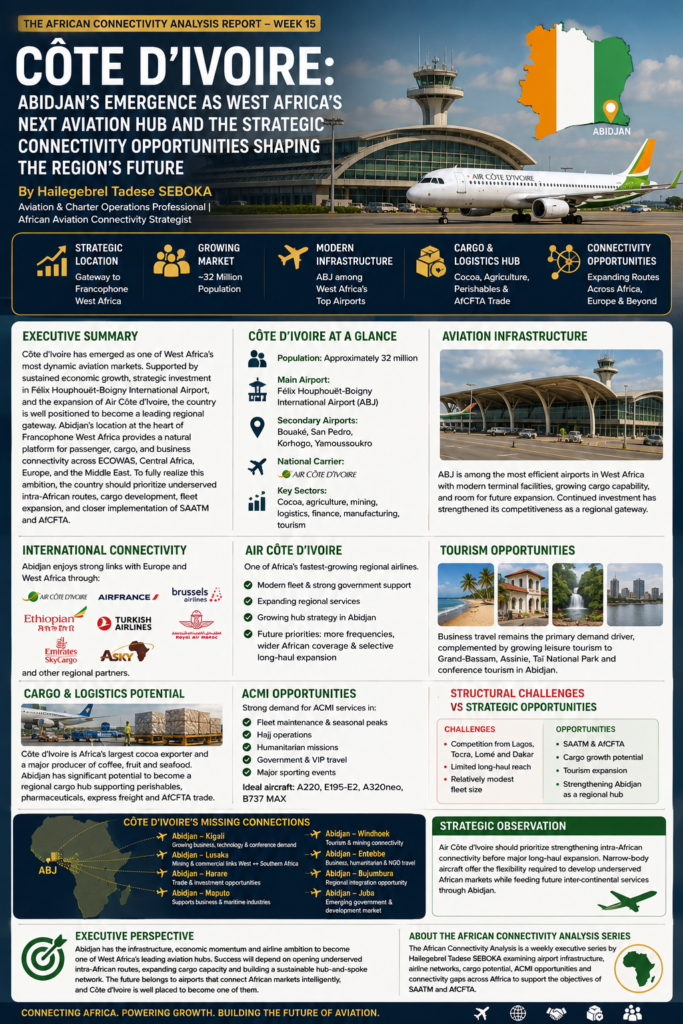
Côte d’Ivoire has emerged as one of West Africa’s most dynamic aviation markets. Supported by sustained economic growth, strategic investment in Félix Houphouët-Boigny International Airport (ABJ), and the expansion of Air Côte d’Ivoire, the country is well-positioned to serve as a primary regional gateway. Abidjan’s location at the heart of Francophone West Africa provides a natural platform for passenger, cargo, and corporate connectivity across ECOWAS, Central Africa, Europe, and the Middle East. To fully realize this ambition, stakeholders must prioritize underserved intra-African routes, perishables cargo infrastructure, tactical ACMI capacity, and closer implementation of SAATM and AfCFTA.
Previous Editions:
Weeks 1–14 covered Rwanda, South Africa, Ethiopia, Kenya, Angola, Nigeria, Zimbabwe, Ghana, Egypt, Senegal, Morocco, Algeria, Tunisia, and Tanzania.
Introduction
This edition evaluates Côte d’Ivoire’s aviation ecosystem, airport infrastructure, national carrier performance, cargo potential, ACMI dynamics, and missing connectivity links that could cement Abidjan’s position among Africa’s premier aviation hubs.
Côte d’Ivoire at a Glance
- Population: ~32 Million
- Main Gateway: Félix Houphouët-Boigny International Airport (ABJ – Abidjan)
- Secondary Airports: Bouaké, San Pedro, Korhogo, Yamoussoukro
- National Carrier: Air Côte d’Ivoire
- Economic Pillars: Cocoa, agriculture, mining, logistics, finance, manufacturing, tourism
Aviation Infrastructure & Gateway Capacity
ABJ is among the most efficient airports in West Africa, featuring modern passenger processing, expanding cold-chain cargo facilities, and clear master-plan capacity for long-term growth. Continuous infrastructure upgrades give Abidjan a distinct competitive edge as a reliable transit hub in the region.
International Connectivity & Network Alliances
Abidjan enjoys robust connectivity to Europe, North Africa, and West/Central Africa through Air Côte d’Ivoire, Air France, Brussels Airlines, Ethiopian Airlines, Turkish Airlines, Royal Air Maroc, ASKY, and strategic cargo carriers (including Emirates SkyCargo partnerships).
Air Côte d’Ivoire: Strategic Ambition vs. Network Density
Air Côte d’Ivoire stands out as a well-managed regional success story. Strengths include a modern fleet (including A220s), strong government backing, and a growing regional hub-and-spoke model. While the airline enters the long-haul arena with its Airbus A330neo operations (connecting Abidjan to markets like Paris and Beirut), its long-term profitability will fundamentally rely on feeding these long-haul flights through a dense, high-frequency West and Central African regional network.
Tourism Opportunities
Business travel remains the primary demand driver, complemented by growing leisure tourism to Grand-Bassam, Assinie, and Taï National Park, as well as expanding conference tourism (MICE) in Abidjan.
Cargo, Logistics & AfCFTA Integration
As the world’s top cocoa exporter and a major producer of coffee, tropical fruit, and seafood, Côte d’Ivoire requires advanced cold-chain air cargo solutions. Abidjan has strong potential to serve as a regional air freight hub for high-value perishables, pharmaceuticals, and express cargo driving cross-border trade under the AfCFTA framework.
ACMI & Supplemental Lift Dynamics
Seasonal demand spikes, scheduled C-checks, Hajj charter operations, government travel, MICE events, and regional sports tournaments present clear opportunities for ACMI wet-lease operators. Optimal aircraft types for this market include the A220, E195-E2, A320neo, and B737 MAX.
Structural Challenges vs. Strategic Opportunities
- Key Challenges: Intense competition from neighboring hubs (Lagos, Accra, Lomé, Dakar), high regional aviation taxes/fees, and thin off-peak yields on non-traditional routes.
- Key Opportunities: SAATM deregulation, AfCFTA trade flows, expanding cold-chain cargo, and capturing transit traffic between Francophone West/Central Africa and global markets.
Côte d’Ivoire’s Missing Connectivity Links
To maximize its hub potential, Abidjan should target high-value intra-African connections—leveraging direct flights, multi-stop tags, or Fifth Freedom rights under SAATM to build load factors sustainably:
- Abidjan – Kigali: Connecting West and East African MICE, technology, and business hubs.
- Abidjan – Lusaka / Harare: Unlocking commercial, agricultural, and mining trade links between West and Southern Africa (via potential triangular routes like ABJ–LUN–HRE).
- Abidjan – Maputo / Windhoek: Supporting energy, maritime, and eco-tourism corridors.
- Abidjan – Entebbe / Juba: Facilitating NGO, diplomatic, trade, and humanitarian logistics (e.g., ABJ–EBB–JUB).
- Abidjan – Bujumbura: Enhancing economic integration between ECOWAS and the East African Community (EAC).
Strategic Observation
Air Côte d’Ivoire’s long-term commercial success relies on building network density across West and Central Africa to support its long-haul widebody expansion. Efficient, right-sized narrow-body aircraft offer the operational flexibility required to test and build high-yield intra-African feeder routes that power intercontinental flights out of Abidjan.
Executive Perspective
Abidjan possesses the infrastructure momentum, economic stability, and geographic position required to consolidate its role as a premier West African hub. Turning this potential into long-term market leadership will require disciplined route development, competitive airport charges, cargo cold-chain expansion, and seamless intra-African connectivity. The future of African aviation belongs to hubs that connect the continent intelligently—and Côte d’Ivoire is well-positioned to lead.
The African Connectivity Analysis is a weekly executive series by Hailegebrel Tadese SEBOKA analyzing airport infrastructure, airline networks, cargo opportunities, ACMI dynamics, and strategic route gaps across Africa to support the objectives of SAATM and AfCFTA.
#AfricanAviation #AviationIndustry #AirCotedIvoire #Abidjan #AirCargo #AviationStrategy #SAATM #AfCFTA #ACMI #AirlineManagement #AfricaTravel