

Namibia: More Routes, But Is Windhoek Building a Network?
Namibia is not Africa’s biggest aviation market, but it is becoming an increasingly compelling one.
The country has steadily expanded its international footprint—particularly to Europe and Southern Africa. However, the fundamental question for route planners and policymakers is whether Windhoek can evolve beyond a collection of point-to-point direct routes to build a truly connected regional network.
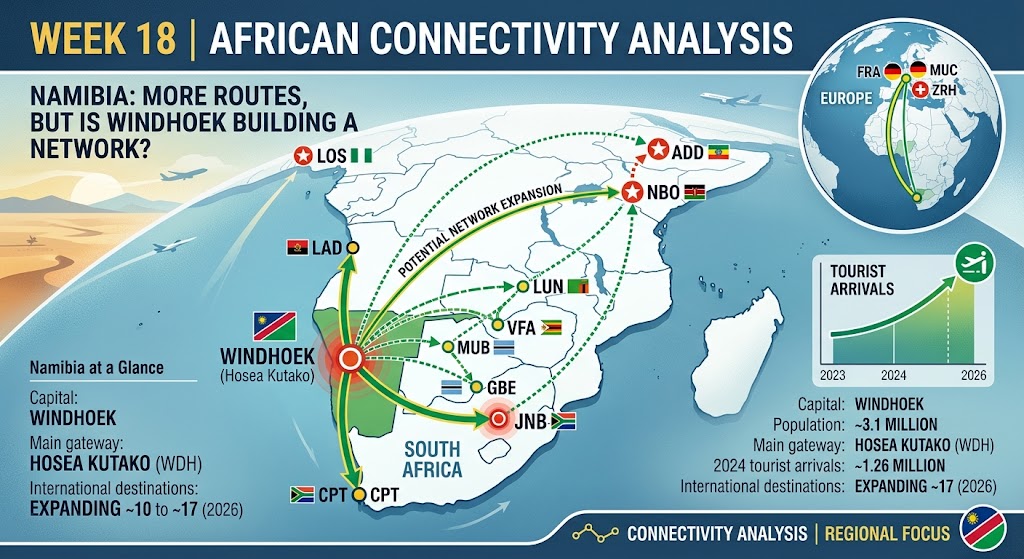
🇳🇦 Namibia at a Glance
- Capital: Windhoek
- Population: ~3.1 million
- Main Gateway: Hosea Kutako International Airport (WDH)
- Key Secondary Gateway: Walvis Bay (WVB)
- Core Markets: Southern Africa & Europe
- 2024 Tourist Arrivals: ~1.26 million
- International Destinations: ~10 (2023) → ~17 (projected 2026)
For a nation of 3.1 million people, Namibia’s international route map is impressive. But looking at destination counts tells only half the story.
Where Namibia is Succeeding
- Europe remains the primary long-haul engine: Frankfurt and Munich provide critical hub connectivity via the Lufthansa Group, complemented by seasonal leisure demand such as Edelweiss’s entry on the Zürich–Windhoek route.
- Southern Africa forms the backbone: Johannesburg and Cape Town account for the vast majority of regional seats, supported by secondary leisure and commercial links to Lusaka, Livingstone, Victoria Falls, Maun, and Luanda. With the void left by Air Namibia’s liquidation, carriers like Airlink, FlyNamibia, and South African Airways continue to shape these flows.
- Addis Ababa provides global reach: Ethiopian Airlines offers Windhoek vital access to one of Africa’s largest connecting hubs, facilitating connections into East/West Africa, Asia, and Europe.
- Emerging regional inter-line activity: Targeted services like Proflight Zambia’s Lusaka–Livingstone–Windhoek link highlight growing interest in cross-border leisure corridors.
Despite these strengths, a major structural gap remains.
The Missing Piece: Intra-African Connectivity
Windhoek still relies overwhelmingly on Johannesburg and Addis Ababa to connect passengers across the rest of the continent.
Which unserved direct routes could fundamentally transform Namibia’s network structure? While not every missing link is commercially viable, several merit serious evaluation:
🇰🇪 Nairobi (NBO)
- The Case: The most significant missing East African link. A direct Windhoek–Nairobi route would link Namibia to a major regional business and aviation hub. Crucially, it would enable high-yield, multi-destination tourism itineraries (e.g., combining a Kenya safari with Sossusvlei/Etosha) while bypassing traditional Sixth Freedom detours.
- Strategic Priority: HIGH | Commercial Risk: MODERATE
🇷🇼 Kigali (KGL)
- The Case: Provides an alternate entry point into the Great Lakes region and accesses RwandAir’s growing feeder network. Given the smaller point-to-point market size, capacity and frequencies would need strict management.
- Strategic Priority: MEDIUM-HIGH | Commercial Risk: MODERATE
🇧🇼 Gaborone (GBE)
- The Case: A direct connection would solidify intra-SADC transport links and support multi-stop itineraries incorporating Maun, Kasane, or Durban. However, previous route suspensions prove that strategic alignment alone isn’t enough—the commercial yields must stack up.
- Strategic Priority: MEDIUM-HIGH | Commercial Risk: MODERATE-HIGH
🇳🇬 Lagos (LOS)
- The Case: Establishes a direct bridge to West Africa’s largest economy, opening avenues for trade, energy, and corporate travel. However, route development must be approached cautiously to avoid over-capacity before demand matures.
- Strategic Priority: HIGH | Commercial Risk: HIGH
🇿🇼 Harare (HRE) & 🇲🇿 Maputo (MPM)
- The Case: Secondary opportunities that enhance East-West connectivity within Southern Africa. These markets are best suited for right-sized regional jet aircraft (e.g., E-Jets or CRJs) rather than narrowbody capacity.
- Strategic Priority: MEDIUM | Commercial Risk: MODERATE
Strategic Roadmap: What Should Namibia Do?
Namibia should avoid launching missing routes simultaneously. Instead, route development should prioritize total network impact.
Recommended Route Prioritization:
- Nairobi 🇰🇪
- Gaborone 🇧🇼
- Kigali 🇷🇼
- Lagos 🇳🇬
- Harare 🇿🇼 / Maputo 🇲🇿
The Strategic Verdict
Windhoek does not need to emulate massive sixth-freedom transfer hubs like Addis Ababa, Nairobi, or Johannesburg.
Instead, Namibia’s path forward lies in establishing a specialized Southern African gateway—a sustainable network built around high-yield tourism, European long-haul feeders, robust SADC regional routes, and targeted links to key African economic nodes.
Namibia’s aviation story is no longer about simply adding destinations on a map. The next phase is transforming those routes into an integrated network.
More routes are good. Better connections are better.