

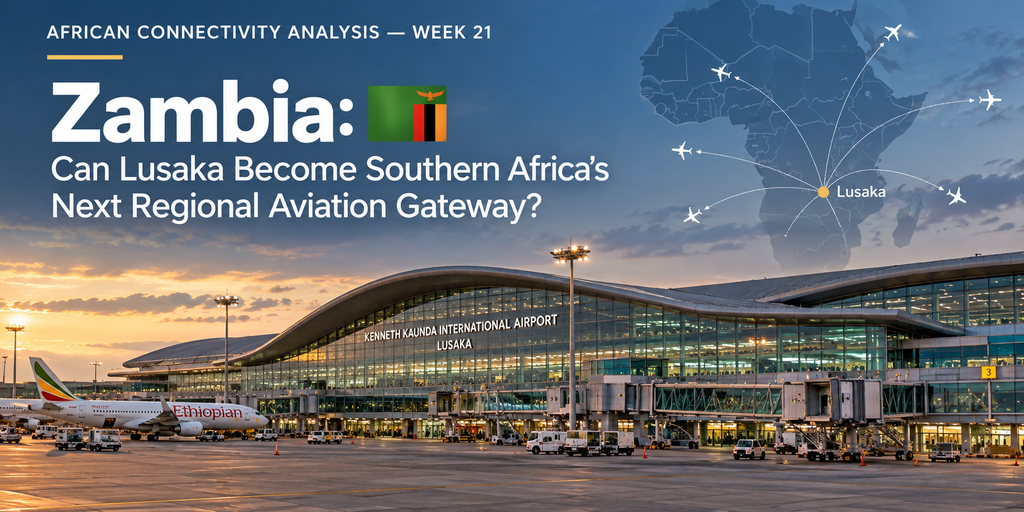
Zambia: Can Lusaka Become Southern Africa’s Next Regional Aviation Gateway?
🌍 20 Countries. 20 Weeks. One African Connectivity Journey.
Before turning to Zambia, I want to pause and celebrate a milestone.
For the past 20 weeks, I have been analysing African aviation markets, one country at a time.
The journey has taken us through:
🇷🇼 Rwanda | 🇿🇦 South Africa | 🇪🇹 Ethiopia | 🇰🇪 Kenya | 🇦🇴 Angola
🇳🇬 Nigeria | 🇿🇼 Zimbabwe | 🇬🇭 Ghana | 🇪🇬 Egypt | 🇸🇳 Senegal
🇲🇦 Morocco | 🇩🇿 Algeria | 🇹🇳 Tunisia | 🇹🇿 Tanzania | 🇨🇮 Côte d’Ivoire
🇹🇬 Togo | 🇳🇦 Namibia | 🇺🇬 Uganda | 🇨🇲 Cameroon | 🇨🇩 Democratic Republic of Congo
20 countries. 20 aviation markets. 20 different connectivity stories.
The objective has never been simply to count airports and routes.
It is to understand where Africa is connected, where the gaps remain, and where aviation can unlock trade, tourism, investment and regional integration.
Now, the journey continues with Country 21 — Zambia 🇿🇲
🇿🇲 ZAMBIA AT A GLANCE
Capital: Lusaka
Main international gateway: Kenneth Kaunda International Airport (LUN)
National airline: Zambia Airways
Scheduled nonstop destinations from Lusaka: 23
Countries served nonstop from Lusaka: 14
Airlines serving Lusaka: 14
Lusaka is already connected to important African markets including Johannesburg, Nairobi, Addis Ababa, Dar es Salaam, Harare, Windhoek, Lubumbashi, Gaborone, Lilongwe, Kigali and Entebbe, as well as international gateways such as Dubai and Doha.
But the real question is not how many destinations Lusaka has.
It is:
How effectively can Lusaka connect markets that are still poorly connected to one another?
✈️ THE CONNECTIVITY GAP
Zambia sits at an important geographic crossroads.
Yet several economically significant African city pairs remain without nonstop connectivity from Lusaka.
This is where the opportunity becomes interesting.
Lusaka–Kinshasa
There is currently no nonstop passenger service between Lusaka and Kinshasa.
Passengers must connect through another African hub, despite the geographic and economic proximity of Zambia and the DRC.
For two neighbouring markets with important commercial, mining and regional links, this is a connectivity gap worth investigating.
Lusaka–Accra
There is currently no nonstop Lusaka–Accra service.
Available one-stop options route passengers through Johannesburg, Nairobi, Addis Ababa, Doha or Dubai.
A direct connection could create a stronger Southern Africa–West Africa bridge, but its commercial viability would need to be tested carefully.
Lusaka–Abidjan
There is also no nonstop Lusaka–Abidjan service.
Current one-stop options include Nairobi, Addis Ababa and Doha.
A direct link could strengthen connectivity between Southern Africa and Francophone West Africa, particularly for business and trade.
Lusaka–Luanda
Lusaka–Luanda is another important corridor to watch.
There is currently no nonstop passenger service, while TAAG has been developing links between Angola and Zambia, including a cargo service launched in 2026.
This makes the corridor particularly interesting from both a passenger and cargo connectivity perspective.
💡 WHY DOES OPENING A NEW ROUTE MATTER?
A new route is not simply another destination on an airport departure board.
A well-designed route can:
Reduce travel time between economic centres
Strengthen regional integration
Connect businesses and investors
Stimulate tourism
Support cargo and trade
Create partnership opportunities for airlines
Increase demand for aviation infrastructure and services
But there is an important distinction:
A connectivity gap does not automatically mean a profitable route.
Before launching a new service, airlines need to assess:
O&D demand + connecting traffic + yields + frequency + aircraft economics + airport costs + traffic rights + seasonality + competitive response.
That is where good aviation strategy begins.
THE RIGHT AIRCRAFT CAN CHANGE THE EQUATION
One of the most important findings from Embraer’s 2026 Africa Connectivity Report is that 55 intra-African city pairs currently have no nonstop service despite demand levels that could potentially support direct operations.
The opportunity is not necessarily about putting large aircraft on every route.
It is about matching:
the right market + the right aircraft + the right frequency + the right commercial model.
That is a particularly important lesson for African airlines.
🇿🇲 ZAMBIA AIRWAYS: A CRITICAL PIECE OF THE PUZZLE
Zambia Airways currently connects Lusaka with Dar es Salaam, Harare, Johannesburg and Nairobi, while also serving Ndola, Livingstone and Solwezi domestically.
The airline’s ownership structure gives it another strategic advantage: the Zambian Industrial Development Corporation holds 55%, while Ethiopian Airlines Group holds 45%.
In August 2026, Aman Wole Gurmu became CEO of Zambia Airways, bringing more than 19 years of international aviation experience.
His mandate includes strengthening the airline’s network, strategic partnerships, operational performance and financial sustainability.
This comes at an important moment for Zambia’s connectivity ambitions.
WHAT SHOULD AIRLINES LOOK AT?
Instead of asking:
“Where can we fly from Lusaka?”
the more strategic question is:
“Which African markets are currently forcing passengers to make inefficient connections?”
That is where potential network opportunities emerge.
For Lusaka, the connectivity gaps toward Central Africa and West Africa deserve particular attention.
But the next route should be determined by market evidence, not geography alone.
WHAT DOES THIS MEAN FOR INVESTORS?
The opportunity is much bigger than airlines.
A stronger Lusaka network can support:
Airlines
Airport infrastructure
Air cargo and logistics
MRO and technical services
Tourism and hospitality
Ground handling
Aviation technology
Business travel
For investors, the question is therefore not only:
“Is there an airline opportunity?”
It is:
“What aviation ecosystem can develop around better connectivity?”
WHAT DOES IT MEAN FOR GOVERNMENT?
For government, route development should be treated as more than aviation policy.
A sustainable new route can contribute to:
Tourism → Trade → Investment → Employment → Regional Integration
This requires coordination between aviation, tourism, trade, investment promotion, airports, airlines and regulators.
The goal should not be to open routes simply to increase the number of destinations.
The goal should be sustainable connectivity that creates measurable economic value.
MY PERSPECTIVE
After analysing 20 African countries, one lesson continues to stand out:
Africa does not necessarily need more mega-hubs.
It needs better-connected markets.
Lusaka has the geography.
It has an international airport with 23 nonstop destinations across 14 countries.
It has a national airline rebuilding its regional network.
It has connections into Southern and Eastern Africa.
And it has an opportunity to strengthen links toward Central and West Africa.
The next step is to turn geographic advantage into network advantage.
Geography creates the opportunity.
Infrastructure creates the capacity.
Airlines create the network.
Partnerships expand the reach.
Commercially sustainable routes create lasting connectivity.
🇿🇲 WEEK 21 — ZAMBIA
Can Lusaka become Southern Africa’s next regional aviation gateway?
And perhaps the more important question:
Which African connectivity gaps should be the next opportunities from Lusaka?
20 countries completed.
21st country now under analysis.
The African connectivity journey continues.
SOURCES
• FlightConnections — Lusaka route network and current nonstop destinations
• Zambia Airways — Company Information and Network
• Zambia Airways — Appointment of Aman Wole Gurmu as CEO